If your cat is constantly scratching, has red or irritated skin, or shows signs of allergies, you may be wondering if Zyrtec (cetirizine) can help and what the correct Zyrtec dosage for cats is. Zyrtec is a common allergy medicine for humans, but it is also sometimes used by veterinarians to help relieve allergy symptoms in cats.
Zyrtec works by blocking histamine, a substance in your cat’s body that causes itching, swelling, and irritation during allergic reactions. Cats with allergies may show symptoms like itchy skin, redness, swelling, watery eyes, or reactions to insect bites. In these cases, Zyrtec can help reduce discomfort and improve your cat’s quality of life.
However, even though Zyrtec is available over the counter, it should only be given to cats under veterinary guidance. It is not officially approved for pets, but vets commonly prescribe it safely in the right dose. Giving the wrong amount can cause side effects or may not work properly.


Zyrtec is mainly used in cats to treat itching, skin allergies, hives, and insect bite reactions. The correct dose depends on your cat’s weight and health, so it’s important to follow proper dosage guidelines.
In this guide, you’ll learn The safe Zyrtec dosage for cats (cetirizine), uses, side effects, and vet-approved guidelines to treat itching, allergies, and skin reactions in cats.
Disclaimer: This content is for informational purposes only and should not replace veterinary advice. Always consult your veterinarian before giving Cetirizine (Zyrtec) or adjusting your cat’s dosage.
Key Takeaways
- Zyrtec (cetirizine) is an antihistamine used in cats to help manage allergy symptoms.
- It works by blocking histamine, which reduces itching, swelling, and inflammation.
- Common uses in cats include itchy skin, hives, insect bites, skin rashes, and mild allergic reactions.
- It may also help in some cases of chronic nasal and sinus inflammation (rhinosinusitis).
- The usual safe dose is 2.5–5 mg once daily, but it must be confirmed by a veterinarian.
- Zyrtec is generally well tolerated in cats, with mild side effects like sleepiness, drooling, or vomiting in some cases.
- Avoid Zyrtec-D (contains pseudoephedrine) and other unsafe combinations, as they can be toxic to cats.
- Effectiveness can vary, so Zyrtec is often used as a supportive or add-on treatment, not a primary cure.
- Always inform your vet about any other medications your cat is taking to avoid drug interactions.
- Veterinary guidance is essential for safe dosing and proper treatment outcomes.
What is Cetirizine Zyrtec for Cats?
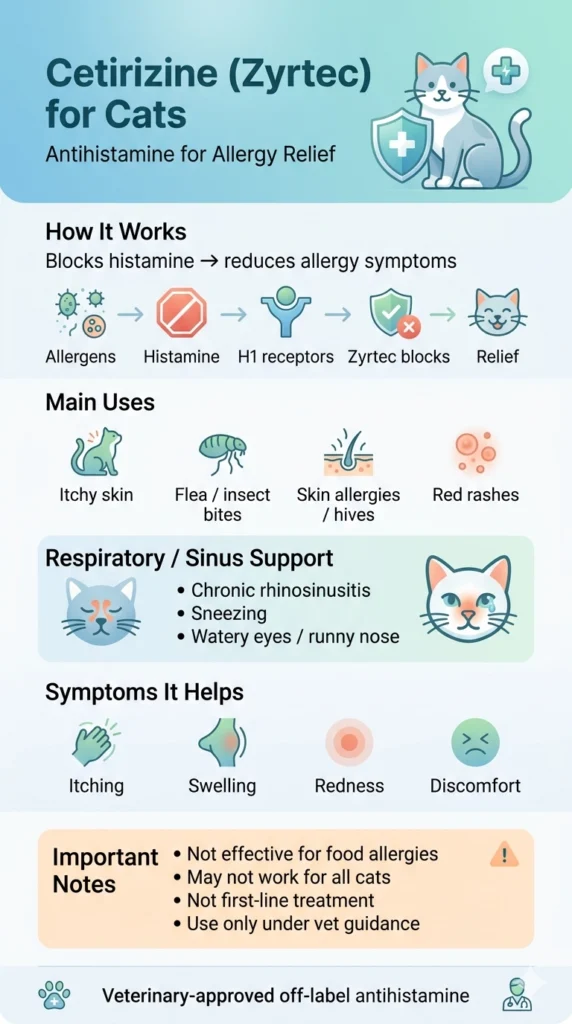
Cetirizine (Zyrtec) is an antihistamine medication used to treat allergies in cats. It works by blocking the effects of histamine, a natural chemical released in your cat’s body during allergic reactions.




When your cat is exposed to allergens, histamine attaches to H1 receptors, causing symptoms like itching (pruritus), redness, swelling, watery eyes, and nasal discharge. Zyrtec helps control these symptoms by blocking these receptors and preventing histamine from triggering allergic reactions.
Zyrtec is a second-generation antihistamine (H1 blocker) and is commonly prescribed by veterinarians as an off-label medication for cats. It is mainly used to treat:
- Itching and skin allergies
- Insect bite reactions
- Chronic nasal and sinus inflammation (rhinosinusitis)
It is usually available in tablet form and should be stored at room temperature (20°–25°C) in a closed container, away from heat, moisture, and sunlight.
Uses of Cetirizine (Zyrtec) for Cats
Zyrtec (cetirizine) is an antihistamine used in cats to reduce allergy symptoms by blocking histamine, a natural chemical released during allergic reactions. When histamine is controlled, it helps reduce itching, swelling, and skin irritation in cats.
Common Uses in Cats
Veterinarians use Zyrtec mainly for:
- Itchy skin (pruritus)
- Hives and skin rashes
- Insect or flea bite reactions
- Allergic skin reactions
These conditions happen when a cat’s body reacts to allergens and releases histamine, causing discomfort.
Nose and Sinus Problems
Zyrtec is sometimes used in cats with long-term nasal issues such as:
- Chronic rhinosinusitis (ongoing nose and sinus inflammation)
It may be used when other treatments are not fully effective, especially after infections.
Allergy Signs It May Help
Zyrtec can also help reduce mild allergy symptoms like:
- Sneezing
- Watery eyes
- Runny nose
But these signs can also be caused by infections, so a vet check is important before treatment.
Important Notes for Cats
- It may not work for all cats (results can vary)
- It is not effective for food allergies
- It is usually not the first treatment choice
Vets often use it as a supportive treatment to help reduce allergy discomfort in cats.
Cetirizine (Zyrtec) Dosage for Cats
The safe Cetirizine (Zyrtec) dosage for cats is commonly used in veterinary medicine to treat allergies such as itchy skin, hives, insect bites, skin rashes, and other allergic reactions. However, the exact dose can vary depending on your cat’s weight, condition, and overall health.
Standard Safe Dosage for Cats
Most veterinarians generally recommend:
- 2.5 mg to 5 mg per cat once daily
- Maximum safe limit: 5 mg per day (without vet approval)
This means most cats respond well within this range, but the exact dose should always be confirmed by a veterinarian.
Weight-Based Dosage Guide
Dosage is usually calculated based on body weight:
- 1 mg per kg of body weight
(or approximately 0.5 mg per pound)
Typically, this results in:
- Small cats: 2.5 mg once daily
- Average cats: 2.5–5 mg once daily
- Larger cats: up to 5 mg once daily
Condition-Based Dosage (Vet Guidelines)
Veterinarians may adjust the dose depending on the condition:
- Itchy skin (pruritus): 2.5–5 mg once daily
- Chronic rhinosinusitis (nose/sinus inflammation): 5 mg once or twice daily
- General allergies (skin, insect bites, rashes): 2.5–5 mg once daily
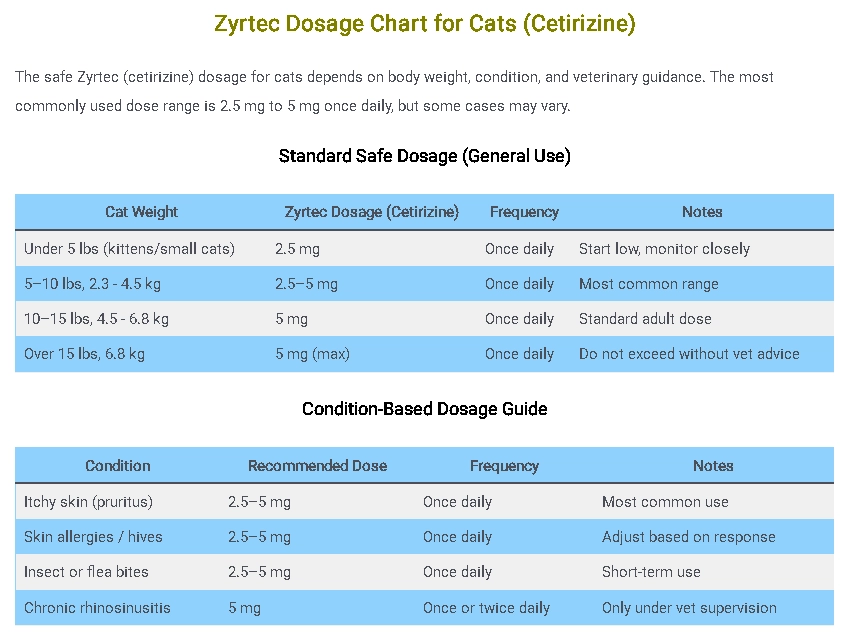
Zyrtec Dosage Chart for Cats (Cetirizine)
The safe Zyrtec (cetirizine) dosage for cats depends on body weight, condition, and veterinary guidance. The most commonly used dose range is 2.5 mg to 5 mg once daily, but some cases may vary.
Standard Safe Dosage (General Use)
| Cat Weight | Zyrtec Dosage (Cetirizine) | Frequency | Notes |
|---|---|---|---|
| Under 5 lbs (kittens/small cats) | 2.5 mg | Once daily | Start low, monitor closely |
| 5–10 lbs, 2.3 – 4.5 kg | 2.5–5 mg | Once daily | Most common range |
| 10–15 lbs, 4.5 – 6.8 kg | 5 mg | Once daily | Standard adult dose |
| Over 15 lbs, 6.8 kg | 5 mg (max) | Once daily | Do not exceed without vet advice |
Condition-Based Dosage Guide
| Condition | Recommended Dose | Frequency | Notes |
|---|---|---|---|
| Itchy skin (pruritus) | 2.5–5 mg | Once daily | Most common use |
| Skin allergies / hives | 2.5–5 mg | Once daily | Adjust based on response |
| Insect or flea bites | 2.5–5 mg | Once daily | Short-term use |
| Chronic rhinosinusitis | 5 mg | Once or twice daily | Only under vet supervision |
Important Safety Notes
- Do not exceed 5 mg per day unless a vet advises it
- Always use plain Zyrtec (cetirizine only)
- Avoid Zyrtec-D (contains pseudoephedrine, which is unsafe for cats)
- Give with or without food (food may reduce vomiting)
- If vomiting or no improvement occurs, consult a vet
Key Reminder
Zyrtec is an off-label medication for cats, meaning it is not FDA-approved for pets but is commonly and safely used by veterinarians when properly dosed.
If your cat does not improve within 1–2 doses or 48 hours, it may mean the condition is not allergy-related, and a veterinary examination is needed.
Summary
The typical safe dosage for cats is 2.5–5 mg once daily, adjusted by weight and condition, with a strict maximum of 5 mg per day unless prescribed otherwise by a veterinarian.
How to Give Zyrtec to Cats: Step-by-Step Administration Guide
Giving Zyrtec (cetirizine) to cats should always be done carefully and only under veterinary guidance. It is given orally (by mouth) and comes in tablet or liquid form, depending on what your veterinarian recommends.
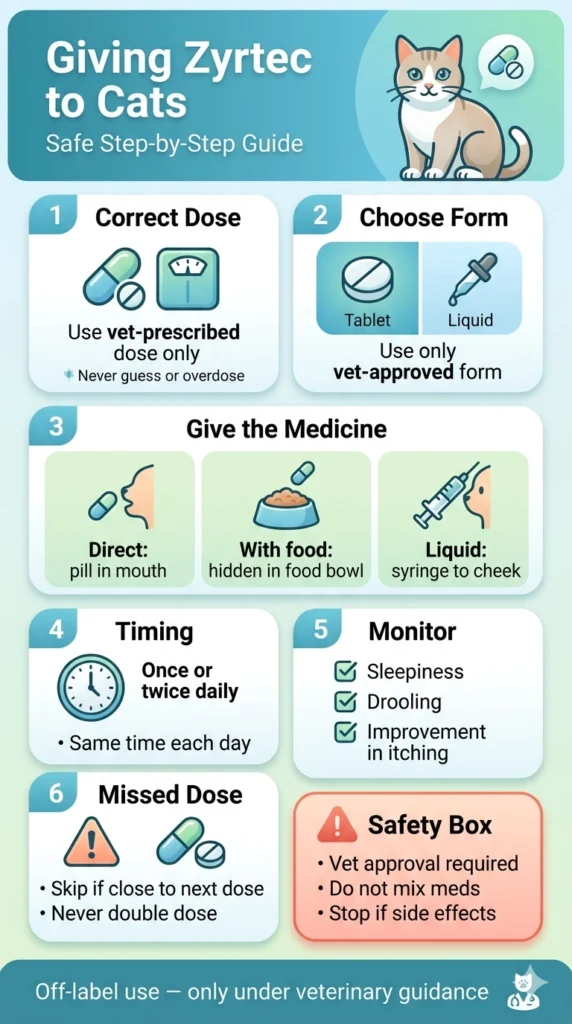
Step 1: Prepare the Correct Dose
- Always use the exact dose prescribed by your vet
- Zyrtec tablets are usually 5 mg or 10 mg
- The dose is often adjusted based on your cat’s condition and weight
Never guess the dose or exceed recommended amounts, as overdose can be dangerous.
Step 2: Choose the Best Form
Zyrtec may be given as:
- Tablet form (most common for cats)
- Liquid form (children’s syrup or compounded liquid)
- Chewable tablets (not always recommended for cats)
Liquid form should only be used if your vet confirms it is safe, as some formulations may contain harmful ingredients for cats.
Step 3: How to Give the Medication
You can give Zyrtec in different ways:
✔ Direct oral method
- Place the tablet in your cat’s mouth
- Use a pill popper if needed
- Gently hold the mouth closed until swallowed
✔ With food
- Hide the tablet in wet food or a small treat (like tuna or soft food)
- Ensure your cat eats the full portion
✔ Liquid form
- Use an oral syringe provided by the vet
- Give slowly into the side of the mouth (cheek area)
Step 4: Timing & Consistency
- Usually given once or twice daily (every 12–24 hours)
- Try to give it at the same time each day
- It can be given with or without food
- If vomiting occurs, giving with food may help
Step 5: Monitor Your Cat
After giving Zyrtec:
- Watch for drooling or mild drowsiness
- Check for any unusual behavior or stomach upset
- Track improvement in itching, redness, or skin irritation
Step 6: Missed Dose Rules
- If once daily: give when remembered (same day only)
- If twice daily: skip missed dose and continue schedule
- Never double the dose to make up for a missed one
Important Safety Notes
- Only give Zyrtec if prescribed by a veterinarian
- Do not use multiple allergy medicines together unless approved
- Stop and contact your vet if side effects appear
- Overdosing can be dangerous for cats
Key Reminder
Zyrtec is an off-label medication in cats, meaning it is not officially approved for animals but is commonly used safely under veterinary supervision.
Zyrtec Side Effects in Cats
Zyrtec (cetirizine) is generally well tolerated in cats when used at the correct dose, and serious side effects are uncommon.
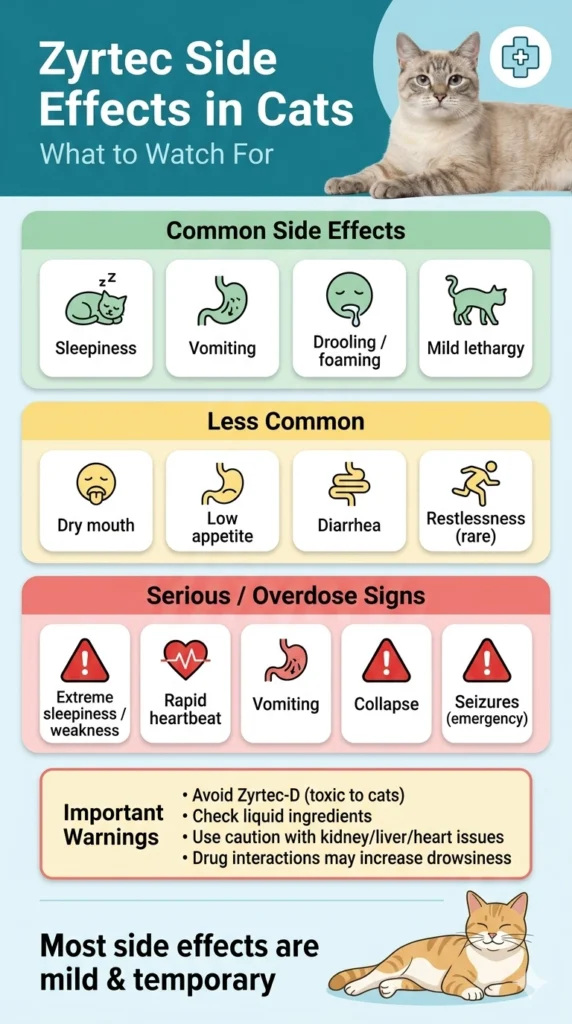
However, some mild reactions can still occur.
Common Side Effects
- Mild drowsiness or sleepiness
- Vomiting or mild stomach upset
- Drooling or hypersalivation
- Foaming at the mouth (often due to taste)
- Temporary lethargy
Less Common Side Effects
- Dry mouth
- Loss of appetite
- Diarrhea
- Mild restlessness (rare)
Signs of Overdose (Serious)
- Severe weakness or extreme sleepiness
- Rapid heartbeat
- Vomiting
- Collapse
- Seizures (very rare but emergency condition)
Important Warnings
- Avoid Zyrtec-D (contains pseudoephedrine, toxic to cats)
- Use caution in cats with kidney, liver, heart, or seizure conditions
- Some liquid syrups may contain harmful ingredients
- Drug interactions may increase drowsiness
Most cats experience only mild and short-term effects, especially during the first dose or when dosage is higher than needed.
Interactions of Zyrtec with Other Pet Medications & Alternatives for Cats
Zyrtec (cetirizine) should only be given to cats after consulting a veterinarian. It is important to inform the vet about all medications, supplements, vitamins, or remedies your cat is currently receiving, as this helps prevent unwanted interactions.
Drug Interactions with Zyrtec
Zyrtec has relatively few drug interactions, but caution is still needed because it may increase drowsiness or affect how other medicines work.
Use caution when combined with:
- Sedatives or calming medications
- e.g., Acepromazine
- May increase drowsiness
- Opioids, Benzodiazepines, or Cannabinoids (CBD)
- Can significantly increase sedation effects
- Cyclosporine (Atopica)
- May reduce absorption
- Should be spaced about 2 hours apart
- Theophylline (asthma medication)
- May increase risk of heart-related side effects
Important Testing Note
- Cats taking Zyrtec (or any antihistamine) may not respond correctly to allergy skin tests
- Antihistamines should be stopped about 1 week before testing, as advised by a veterinarian
When Zyrtec May Not Be Enough
Zyrtec is often used as a supportive treatment, not a primary solution. In many cats, it may not fully control itching or chronic skin problems.
Veterinarians may recommend other treatments such as:
- Corticosteroids (e.g., prednisolone)
- Immune suppressants (cyclosporine, oclacitinib)
- Allergen-specific immunotherapy
- Essential fatty acids
- Maropitant or gabapentin
For chronic rhinosinusitis, antibiotics are usually the main treatment, while antihistamines like Zyrtec may only provide limited support.
Alternative Medications if Zyrtec Is Not Effective
If Zyrtec does not work well, veterinarians may consider other options:
- Diphenhydramine (Benadryl) – short-term itching relief
- Hydroxyzine / Chlorpheniramine / Clemastine / Fexofenadine / Loratadine – alternative antihistamines
- Cyproheptadine or Amitriptyline – stronger antihistamine effects
- Cytopoint injection – long-term allergy control
- Apoquel (oclacitinib) – severe allergy management
- Prednisolone – inflammation control (with caution)
- Omega-3 fatty acids & probiotics – supportive skin health
- Flea prevention (e.g., Bravecto) – for flea-related allergies
- Hypoallergenic diet – for food allergy cases
Key Insight
Veterinary research shows that antihistamines like Zyrtec work best as supportive or add-on therapy, not as the only treatment for cat allergies. If Zyrtec is not effective, alternative medications or treatments may be required depending on the cause of the allergy.
How Cetirizine Compares to Other Antihistamines in Cats
Cetirizine (Zyrtec) belongs to the group of antihistamine medicines used in veterinary care, but it has some important differences compared to other common options like diphenhydramine (Benadryl®), loratadine (Claritin®), and hydroxyzine.
Antihistamine Classes Explained
Antihistamines are generally divided into different classes:
- First-generation antihistamines
- Example: Diphenhydramine (Benadryl®)
- Can cross into the brain and affect the sleep/wake cycle
- Often causes more sedation or drowsiness
- Second-generation antihistamines
- Example: Cetirizine (Zyrtec), Loratadine (Claritin®)
- Designed to cause less drowsiness
- More suitable for daytime or long-term use
- H2 blockers (another histamine class)
- Example: Famotidine
- Works on histamine in the digestive system, not allergy symptoms
Cetirizine is a second-generation H1 antihistamine, meaning it mainly targets allergy-related histamine and usually causes less sedation than older drugs.
Cetirizine vs Other Antihistamines
- Cetirizine (Zyrtec)
- Lower sedation in most cats
- Often used once daily
- Preferred for mild or chronic allergies
- Diphenhydramine (Benadryl®)
- Works for acute allergic reactions
- Causes more sleepiness
- May need multiple doses per day
- Hydroxyzine
- Strong anti-itch effect
- More sedating than cetirizine
- Loratadine (Claritin®)
- Less sedating
- May have drug interaction limitations in some cases
When Vets Prefer Cetirizine
Veterinarians often choose cetirizine when:
- A low-sedation option is needed
- The cat has mild or seasonal allergies
- Long-term, once-daily treatment is preferred
However, response can vary, and some cats may still need other treatments like medicated shampoos, omega-3 supplements, or prescription allergy medicines for better control.
Key Insight
Cetirizine is considered a balanced antihistamine option—less sedating than older drugs like diphenhydramine, but not always as strong as hydroxyzine for severe itching. Its effectiveness depends on the individual cat and the severity of the allergy condition.
You May Also Like To Read:
- Hydroxyzine Dosage for Cats: Chart, Safe Use, Effects & More
- Benadryl Dosage for Cats: Chart, Safe Use & Vet Guide
FAQs About Zyrtec Dosage for Cats (Cetirizine)
Can I give my cat Zyrtec every day?
Yes, when prescribed by a veterinarian, Zyrtec can be given daily to cats as directed. It is generally safe for daily use, but its effectiveness may vary depending on the cat. In some cases, it may also help reduce the need for corticosteroids used to control itching.
How quickly does Zyrtec work in cats?
Zyrtec starts working fairly quickly, usually within about 1 hour after dosing, and each dose typically lasts for around 24 hours.
Which cats should not take Cetirizine (Zyrtec)?
Zyrtec should not be given to cats with certain conditions unless a veterinarian approves it:
Cats with hypersensitivity to antihistamines
Cats with kidney (renal) or liver disease
Pregnant or lactating cats
Can you crush Zyrtec for cats?
Yes, Zyrtec tablets can be crushed into a proper dose if your cat cannot swallow pills. You can also use a liquid form if prescribed. Make sure it is prepared cleanly and accurately to avoid incorrect dosing or contamination.
Is there any monitoring required for Zyrtec use in cats?
No strict monitoring is required, but follow-up vet visits are important to check how well your cat is responding. At home, you should watch for any side effects such as sleepiness, vomiting, or unusual behavior.
Can I give my cat Zyrtec-D?
No. Zyrtec-D is dangerous for cats because it contains pseudoephedrine, which is toxic and can cause serious or even fatal reactions. Never give this form to your cat.
Is Zyrtec effective for cats?
Zyrtec can help with mild itching and allergy symptoms, but it may not work well for severe or chronic allergies. In stronger cases, cats may need prescription treatments, diet changes, or flea control instead.
What happens if I miss a dose?
If you miss a dose, give it as soon as you remember—unless it is close to the next scheduled dose. If so, skip the missed dose and continue the regular schedule. Never give two doses at once.
What should I do if Zyrtec doesn’t work?
If your cat shows no improvement after consistent dosing, it may not be effective for their condition. In that case, your veterinarian may recommend other treatments such as prescription allergy medications, steroids, diet changes, or flea control.
Final Thoughts
Zyrtec (cetirizine) can be a helpful option for managing allergy-related problems in cats, especially symptoms like itchy skin, hives, insect bites, and mild sinus or nasal inflammation. It works by blocking histamine, the chemical responsible for triggering allergic reactions in your cat’s body.
However, it is important to remember that Zyrtec is not a cure-all solution. In many cats, its effectiveness can vary, and it may work best only as a supportive or additional treatment, rather than the main therapy for allergies.
While Zyrtec is generally considered safe when used at the correct dose, it should always be given under veterinary supervision, as factors like your cat’s weight, health condition, and other medications can affect safety and results. Avoid dangerous formulations like Zyrtec-D, and never exceed the recommended dose.
If your cat does not improve within a short period or shows signs of side effects, it is important to consult a veterinarian for further evaluation and alternative treatment options.
In summary, Zyrtec can help improve comfort and reduce allergy symptoms in many cats—but the best results always come from proper diagnosis, correct dosing, and veterinary guidance.