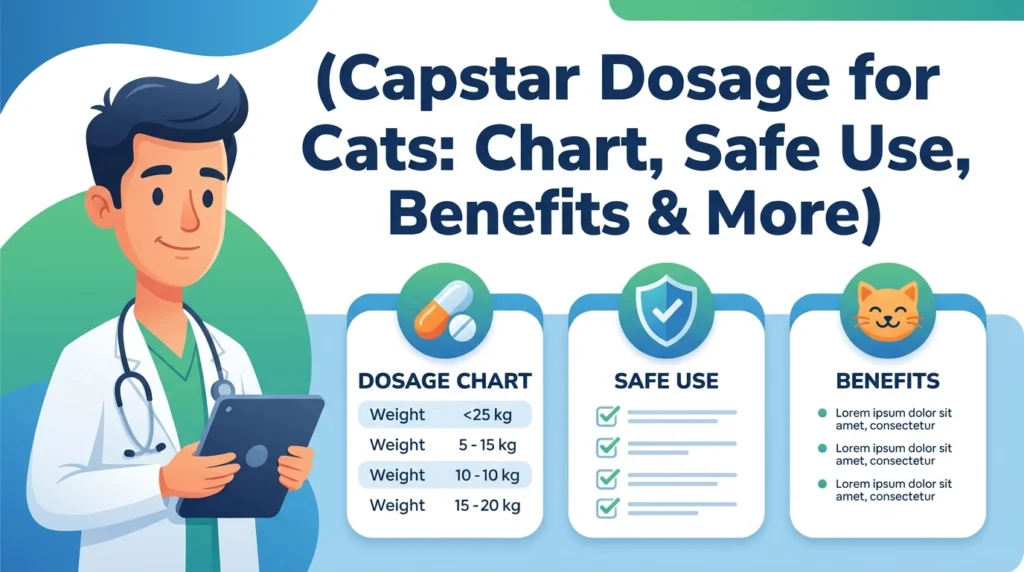
When your cat is dealing with fleas, quick relief becomes the top priority—and understanding the right Capstar dosage for cats is essential. Capstar is an over-the-counter oral flea treatment that contains nitenpyram, a fast-acting ingredient designed to kill adult fleas on cats within hours.
This medication is especially helpful during heavy flea infestations, where constant scratching and blood loss can make your cat uncomfortable or even weak. Unlike long-term flea treatments, Capstar works quickly but does not provide lasting protection, so it is often used together with other flea prevention methods.
Capstar works in a simple but effective way. When fleas bite your cat, they ingest nitenpyram, which attacks their nervous system by blocking signals needed for movement. This causes the fleas to become paralyzed and die rapidly, giving your cat fast relief.


For many cat owners, Capstar is a reliable choice because it is easy to give and starts working quickly. Generic versions of nitenpyram are also available, offering the same results at a lower cost. However, giving the correct dose based on your cat’s weight is very important to ensure safety and effectiveness.
While Capstar is generally safe for cats, some may experience mild side effects like slight tiredness, reduced appetite, or occasional vomiting. These effects are usually temporary, but proper dosing helps reduce any risks.
In this guide, you’ll learn the correct Capstar dosage for cats, how Capstar (nitenpyram) works, correct dosing, uses, side effects, safety, and FAQs for fast flea relief in cats and kittens.
Disclaimer: This content is for informational purposes only and should not replace veterinary advice. Always consult your veterinarian before giving Capstar (nitenpyram) or adjusting your cat’s dosage.




Key Takeaways
Capstar is a fast-acting oral flea treatment for cats that works through its active ingredient nitenpyram to quickly kill adult fleas after a single dose.
- Capstar begins working within 30 minutes and kills most adult fleas within a few hours
- It is used for rapid relief during flea infestations, especially when cats are heavily infested
- It only kills adult fleas, not eggs, larvae, or pupae
- It does not provide long-term protection, so it must be combined with other flea prevention methods
- It is generally safe for cats that are 4 weeks or older and weigh at least 2 pounds
- Mild side effects like itching or restlessness may occur due to flea die-off, not the medication itself
- Correct dosage and weight-based use are important for safety and effectiveness
- Environmental flea control is necessary to prevent reinfestation
What is Capstar for Cats?
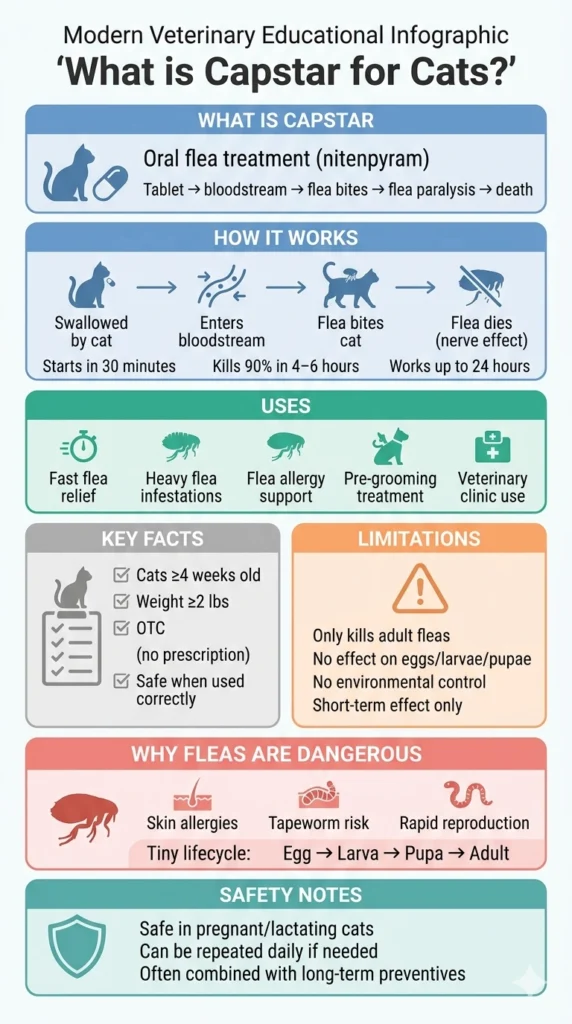
Capstar is a flea treatment for cats that contains nitenpyram as its active ingredient. It is given as a tablet by mouth.
After a cat swallows Capstar, the medicine is absorbed into the bloodstream and spreads through the body. When fleas bite the cat, they ingest the medication through the blood. This causes neurological problems in the fleas, leading to paralysis and death within a few hours.
Capstar is used to quickly kill adult fleas on cats. It does not kill flea eggs, larvae, or pupae, and it does not treat fleas in the environment.
Uses of Capstar in Cats
Capstar is a fast-acting oral tablet used in cats and kittens to quickly kill adult fleas. It starts working within about 30 minutes and can kill over 90% of fleas within 6 hours, with activity lasting up to 24 hours.
It is labeled for use in:
- Cats and kittens 4 weeks of age or older
- Cats weighing at least 2 pounds
- Available as an over-the-counter treatment (no prescription required)
Why Capstar is Used in Cats
Fleas are not just annoying—they can cause serious health problems in cats, including:
- Flea allergy dermatitis (skin reaction caused by flea bites)
- Tapeworm infection (from swallowing infected fleas)
Fleas also reproduce extremely fast:
- A single female flea can lay up to 50 eggs per day
- One flea may produce around 2,000 eggs in its lifetime
- Eggs develop into larvae → pupae → adult fleas
Because of this rapid cycle, even a small infestation can grow quickly if not treated.
Main Uses of Capstar in Cats
Capstar is mainly used for fast flea removal, especially in situations like:
- Heavy flea infestations needing immediate relief
- Cats with flea allergy reactions (quickly stops biting fleas)
- Preventing fleas from spreading to other pets
- Reducing fleas before bathing or grooming a heavily infested cat
- Short-term control in veterinary clinics before procedures
Important Limitations
- Works only on adult fleas
- Does not kill flea eggs, larvae, or pupae
- Does not treat fleas in the environment
- Effect lasts only about 24 hours
- New fleas can reappear if the environment is not treated
Because of this, veterinarians usually combine it with other flea preventatives for long-term control.
Additional Veterinary Use
In some cases, veterinarians also use Capstar off-label to help manage:
- Maggots in wounds (especially in outdoor cats)
It may also be used in veterinary clinics to quickly remove fleas and prevent spreading to other animals.
Safety Notes
- Can be given once daily if needed
- Considered safe for pregnant and lactating cats
- Often used as part of a complete flea control plan
How Capstar Works in Cats
Capstar, also known as nitenpyram, is given as a tablet by mouth to cats. After swallowing, it is absorbed into the bloodstream and starts circulating in the body.
When fleas bite the treated cat, they ingest the medication through the blood. This causes neurological problems in the fleas, leading to paralysis and death within a few hours.
Capstar works quickly, killing adult fleas within about 30 minutes and removing most adult fleas within 4 to 6 hours.
However, it only works on adult fleas. It does not kill flea eggs, larvae, or pupae, and it does not treat fleas in the environment.
Capstar Dosage for Cats
Capstar comes in a single-dose tablet form designed for fast flea relief in cats.
Standard Capstar Dosage for Cats
According to the manufacturer:
- Cats weighing 2–25 lbs should receive one 11.4 mg tablet
- Given by mouth (oral administration)
- Can be given with or without food
- Safe to repeat once every 24 hours if needed
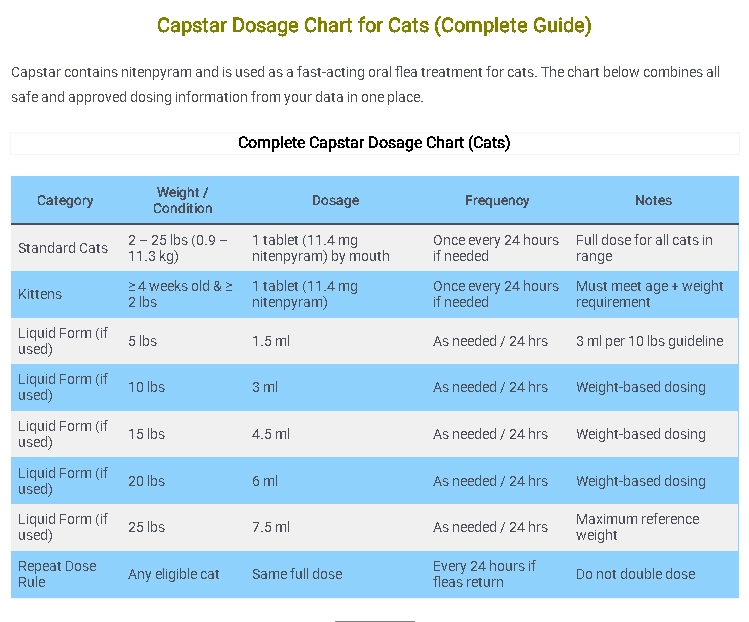
Capstar Dosage Chart for Cats (Complete Guide)
Capstar contains nitenpyram and is used as a fast-acting oral flea treatment for cats. The chart below combines all safe and approved dosing information from your data in one place.
Complete Capstar Dosage Chart (Cats)
| Category | Weight / Condition | Dosage | Frequency | Notes |
|---|---|---|---|---|
| Standard Cats | 2 – 25 lbs (0.9 – 11.3 kg) | 1 tablet (11.4 mg nitenpyram) by mouth | Once every 24 hours if needed | Full dose for all cats in range |
| Kittens | ≥ 4 weeks old & ≥ 2 lbs | 1 tablet (11.4 mg nitenpyram) | Once every 24 hours if needed | Must meet age + weight requirement |
| Liquid Form (if used) | 5 lbs | 1.5 ml | As needed / 24 hrs | 3 ml per 10 lbs guideline |
| Liquid Form (if used) | 10 lbs | 3 ml | As needed / 24 hrs | Weight-based dosing |
| Liquid Form (if used) | 15 lbs | 4.5 ml | As needed / 24 hrs | Weight-based dosing |
| Liquid Form (if used) | 20 lbs | 6 ml | As needed / 24 hrs | Weight-based dosing |
| Liquid Form (if used) | 25 lbs | 7.5 ml | As needed / 24 hrs | Maximum reference weight |
| Repeat Dose Rule | Any eligible cat | Same full dose | Every 24 hours if fleas return | Do not double dose |
Important Safety Notes (From Your Data)
- Works only on adult fleas
- Does not kill eggs, larvae, or pupae
- No long-term protection
- Must be combined with other flea control methods for full results
- Always ensure correct weight-based dosing before administration
How Often Can It Be Given?
- Most cases: single one-time dose
- If fleas return: once every 24 hours
- In some flea control situations: may be used once daily to once weekly under guidance to manage re-infestation
Important Dosage Guidance (Weight-Based Use)
- Designed for cats 2 to 25 lbs
- Safe for cats 4 weeks of age and older
- Always ensure correct use based on your cat’s body weight
How to Give Capstar (Nitenpyram) to Cats Step by Step
Capstar contains nitenpyram and is given to cats to quickly kill adult fleas. Giving it correctly helps reduce stress for your cat and ensures the treatment works properly.
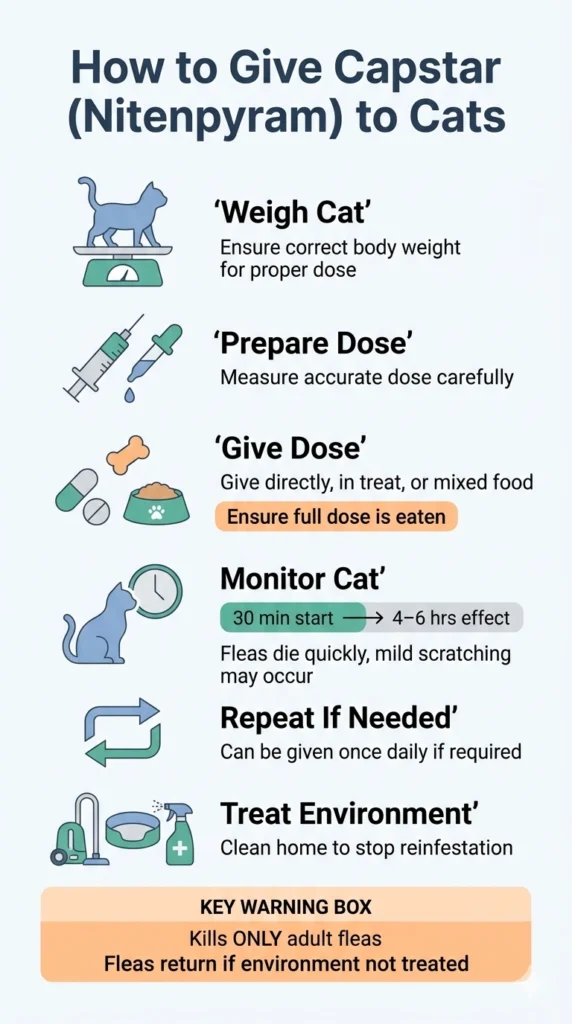
Step 1: Weigh Your Cat
- Use a pet scale, or
- Weigh yourself holding your cat, then subtract your weight
This is important because accurate body weight ensures correct dosing, especially for kittens close to the minimum weight requirement.
Step 2: Prepare the Correct Dose
- Standard guideline: 3 ml per 10 lbs of body weight (for liquid form if used)
- Use a syringe or dropper to measure carefully
- Small cats require extra accuracy to avoid incorrect dosing
Step 3: Give the Dose
You can administer Capstar or nitenpyram in different ways:
- Directly into the cat’s mouth
- Hidden in a small treat or pill pocket
- Mixed into a small amount of wet food
If using food, make sure your cat eats the full dose before walking away.
Step 4: Monitor Your Cat
- Nitenpyram starts working within 30 minutes
- Fleas begin dying quickly and may become more active briefly
- Some cats may scratch more for a short time
- Most fleas are reduced within 4–6 hours
Step 5: Repeat If Needed
- If fleas return, a dose can be given once daily
- If unsure whether the full dose was taken, it is safe to repeat
- Keep track of dosing time to avoid confusion
Step 6: Treat the Environment
Flea control is not only about the cat:
- Fleas lay eggs in carpets, bedding, and furniture
- Eggs hatch and restart infestation
- Regular vacuuming and washing bedding is important
- Environmental treatment helps stop reinfestation
Important Usage Note
- One dose kills adult fleas only
- If fleas return, it usually means reinfestation from the environment
- Long-term flea prevention may be needed for full control
Side Effects of Capstar in Cats
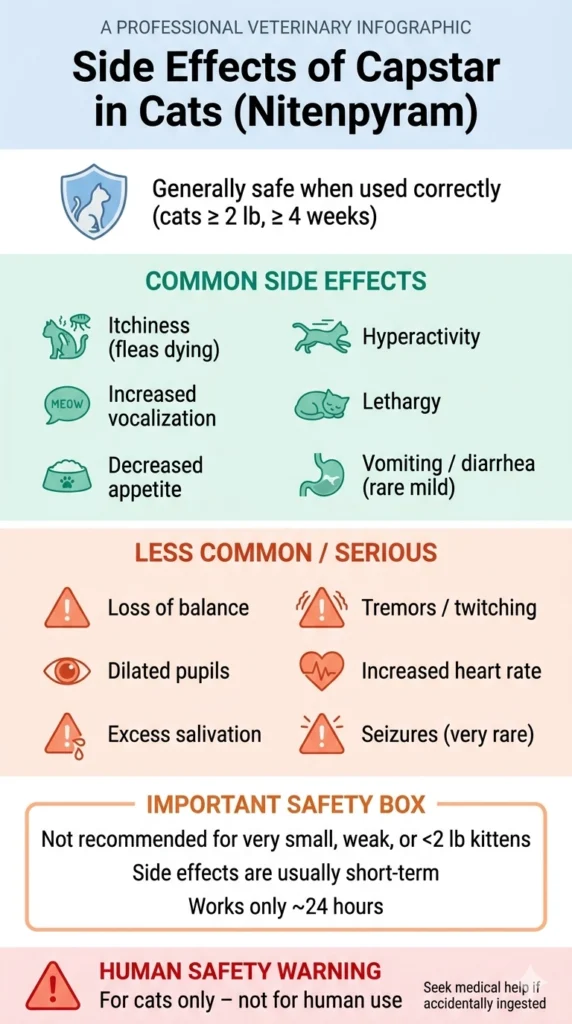
Capstar is labeled for cats and kittens weighing 2 lb or more and older than 4 weeks of age. It is generally considered a very safe flea treatment when used correctly.
Research shows that nitenpyram is highly selective for insect nervous system receptors compared to those in cats, dogs, and humans. Because of this, it is unlikely to strongly affect the cat’s body. Even when used at doses higher than recommended, studies have not shown major adverse effects in most cases.
Common Side Effects in Cats
Some cats may experience mild and short-term effects after treatment, including:
- Scratching or increased itchiness (often due to dying fleas, not the medicine itself)
- Hyperactivity
- Vocalization (meowing more than usual)
- Excessive grooming or licking
- Lethargy
- Decreased appetite
- Vomiting
- Diarrhea
These signs are usually temporary and resolve as the fleas die and leave the cat’s body.
Less Common or Serious Side Effects
In rare cases, more serious reactions have been reported, especially in:
- Cats weighing less than 2 pounds
- Very young or weak kittens (under 8 weeks)
- Thin or emaciated cats
Possible serious effects include:
- Incoordination (loss of balance)
- Trembling or muscle twitching
- Dilated pupils
- Increased heart rate
- Drooling (hypersalivation)
- Difficulty breathing
- Seizures (very rare)
These neurological signs are uncommon and should be treated seriously if they occur.
Important Safety Notes
- Capstar is considered safe for breeding, pregnant, and lactating cats
- It can be used with other flea treatments (such as long-acting preventives)
- Some reactions may be linked to the flea die-off process, not the drug itself
- Most side effects are short-lived because Capstar works for only about 24 hours
Human Safety Warning
- Capstar is for cats only
- It should not be used by humans
- If accidentally ingested, seek medical help or contact Poison Control (800-222-1222) immediately
Storage, Safety, and Key Facts About Nitenpyram (Capstar) in Cats
Capstar contains the active ingredient nitenpyram, which is used to quickly kill adult fleas in cats. It works after being swallowed, entering the bloodstream, and affecting fleas when they bite and feed on the cat.
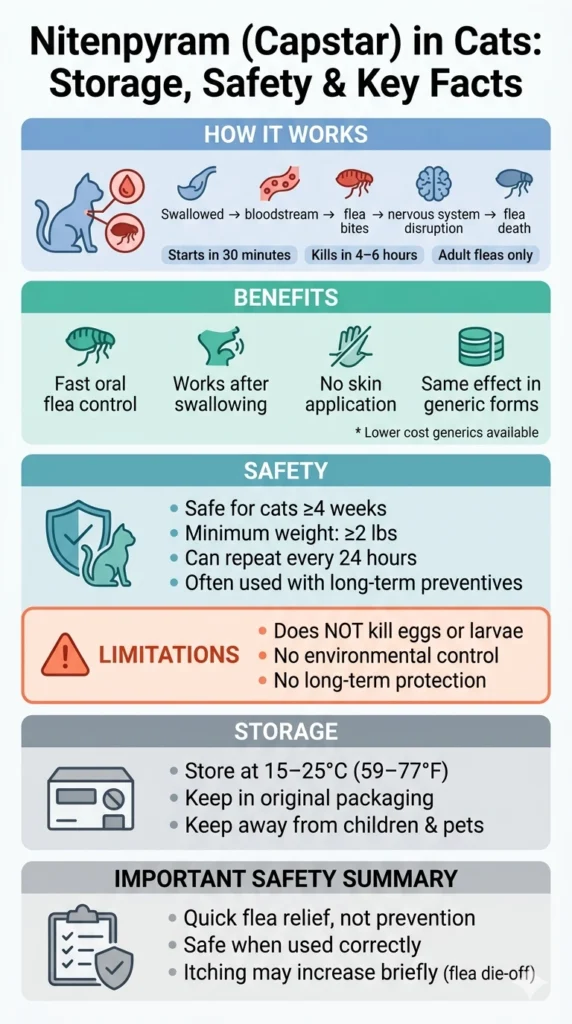
How Nitenpyram Works Against Fleas
Nitenpyram works by disrupting the nervous system of adult fleas, causing rapid paralysis and death.
Key points:
- Absorbed into the cat’s bloodstream after swallowing
- Fleas are affected when they bite and feed on the cat
- Begins killing fleas within 30 minutes
- Clears most adult fleas within 4 to 6 hours
- Only kills adult fleas, not eggs, larvae, or pupae
- Does not treat fleas in the environment
Because of this, it gives fast relief but does not break the full flea life cycle alone. Long-term flea prevention is needed for ongoing control.
Benefits of Generic Nitenpyram
The active ingredient in Capstar is nitenpyram, and generic versions contain the same ingredient with the same effect.
Key benefits:
- Same flea-killing action as brand-name Capstar
- Works through the same biological mechanism
- Main difference is lower cost
Common generic options include:
- CapAction
- CapGuard
- PetArmor (nitenpyram products)
Additional advantages of oral nitenpyram for cats:
- No need for skin application
- Not affected by grooming behavior
- Works immediately after swallowing
- Easier than bathing or topical treatments
Safety of Nitenpyram in Cats
Nitenpyram is FDA-approved for cats and has a long safety record in veterinary use.
Safe use guidelines:
- For cats 4 weeks of age or older
- Minimum weight: 2 pounds
- Can be repeated once every 24 hours if needed
- Often used alongside monthly flea preventatives
Most reactions seen after use are not harmful but are linked to flea death activity:
- Increased scratching shortly after dosing
- Temporary restlessness as fleas die
Serious side effects are rare, but overdose may cause:
- Excessive vocalization
- Panting
- Agitation
If overdose is suspected, veterinary help should be contacted immediately.
How To Store Capstar for Cats
Proper storage helps maintain effectiveness:
- Store at controlled room temperature (59–77°F / 15–25°C)
- Keep tablets in original packaging until use
- Keep out of reach of children and pets
Important Safety Summary
- Safe for kittens 4 weeks and older
- Must weigh at least 2 pounds
- Works only on adult fleas
- No long-term protection (needs preventive treatment)
- Can be used again if fleas return
- Some itching after treatment may be due to flea die-off, not medication reaction
- Fexofenadine Dosage for Cats: Chart, Safe Use, Benefits & Risks
- Zyrtec Dosage for Cats (Cetirizine): Chart, Safety & More
FAQs About Capstar for Cats
How quickly does nitenpyram work on cats?
Capstar begins killing adult fleas within 30 minutes after dosing. Most fleas are eliminated within 4 to 6 hours, making it one of the fastest oral flea treatments for cats.
Can I give nitenpyram to a kitten?
Yes. nitenpyram is safe for kittens that are:
At least 4 weeks old
Weigh at least 2 pounds
Accurate weighing is important to ensure correct dosing, especially for young kittens.
Is generic nitenpyram as effective as Capstar?
Yes. Generic versions contain the same active ingredient as Capstar and work in the same way.
Examples include:
CapAction
CapGuard
PetArmor
Effectiveness is the same—the main difference is cost, not performance.
How often can I give nitenpyram to my cat?
It can be given:
Once every 24 hours if needed
Whenever fleas reappear between treatments
If frequent dosing is needed, it usually indicates environmental reinfestation, which also needs treatment.
Does Capstar provide lasting flea protection?
No. It only kills adult fleas present at the time of dosing.
It does not:
Kill flea eggs or larvae
Provide long-term protection
A monthly flea preventive is recommended for ongoing control.
Is Capstar safe for cats?
Yes. It is generally safe for cats that are:
At least 4 weeks old
Weigh 2 pounds or more
Veterinary advice is recommended for pregnant, nursing, senior, or sick cats.
Does nitenpyram interact with other medications?
No known drug interactions exist. However, it is still best to inform your veterinarian about any medications or supplements your cat is receiving.
Is Capstar safe for nursing cats?
Yes, it is considered safe for pregnant and lactating cats when used as directed.
Final Thoughts
Capstar is a fast-acting oral treatment designed to quickly eliminate adult fleas in cats. Its active ingredient, nitenpyram, works through the bloodstream and begins killing fleas within minutes of administration, providing rapid relief during active flea infestations.
While Capstar is highly effective at killing adult fleas, it is important to remember that it does not affect flea eggs, larvae, or pupae, and it does not provide long-term protection. Because of this, it is best used as an immediate solution for flea control while a longer-term preventive plan is in place.
Proper dosing, correct administration, and understanding how often it can be repeated are essential for safe and effective use. When used correctly in cats that meet the age and weight requirements, Capstar is generally well-tolerated and considered a reliable option for fast flea relief.
In summary, Capstar plays an important role in quickly reducing flea infestations in cats, especially when immediate action is needed, but it works best as part of a complete flea management strategy that includes ongoing prevention and environmental control.