When your cat develops a bacterial infection, choosing the right antibiotic and giving the correct Orbax dosage for cats is essential for a safe and effective recovery. Orbax, the brand name for orbifloxacin, is a commonly prescribed veterinary antibiotic used specifically to treat bacterial infections in cats.
Veterinarians typically prescribe orbax for cats to treat conditions such as skin infections, soft-tissue wounds, abscesses, and urinary tract infections (UTIs). This antibiotic works by stopping bacteria from multiplying, helping your cat’s body eliminate the infection more effectively.
Orbax is available in both tablet and liquid (oral suspension) forms, making it easier for cat owners to administer at home—especially if their cat prefers liquid medication. However, it’s important to know that orbax for cats dosage must always be determined by a veterinarian, as it depends on your cat’s weight, health condition, and type of infection.


In this guide, you’ll learn Orbax dosage for cats guide covering uses, dosing, side effects, safety, and proper administration of orbifloxacin to treat bacterial infections in cats safely.
Disclaimer: This content is for informational purposes only and should not replace veterinary advice. Always consult your veterinarian especially if your cat has existing health conditions or is taking other medications before giving Orbax or adjusting your cat’s dosage.
Key Takeaways
- Orbax for cats is a veterinary antibiotic containing orbifloxacin, used to treat bacterial infections.
- The typical orbax dosage for cats is 2.5–7.5 mg/kg once daily, but always follow your veterinarian’s prescription.
- It is commonly prescribed for skin infections, wounds, abscesses, and urinary tract infections.
- Orbax works by blocking bacterial DNA synthesis, which kills the bacteria.
- Available in tablet and oral suspension, with the liquid form being easier to give to cats.
- Best given on an empty stomach, but can be given with a small amount of food if stomach upset occurs (avoid calcium-rich foods).
- Complete the full course of treatment, even if your cat starts improving.
- Common side effects include vomiting, diarrhea, and loss of appetite, which are usually mild.
- Serious side effects like vision changes or seizures are rare but require immediate veterinary attention.
- Certain substances (like calcium, iron, and antacids) can reduce absorption—give them at least 2 hours apart.
- Always inform your vet about other medications or supplements your cat is taking.
What Is Orbax for Cats?
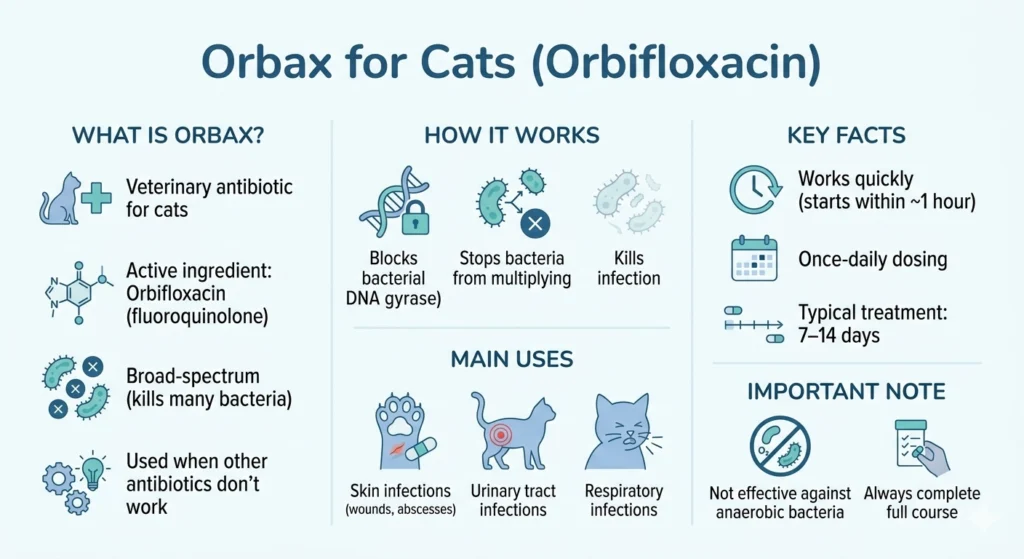
Orbax is a veterinary antibiotic used in cats, and its active ingredient is orbifloxacin, a broad-spectrum drug from the fluoroquinolone class. Because this group of antibiotics is very important in human medicine, veterinarians usually prescribe orbax for cats only when other first-line treatments are not suitable or have not worked.
Before using this medication, a veterinarian will often perform a culture and sensitivity test. This helps identify the exact bacteria causing the infection and ensures the most effective antibiotic is chosen, which also helps reduce antibiotic resistance.




Orbifloxacin works by killing bacteria and is effective against both gram-positive and gram-negative bacteria. It is especially useful against Staphylococci bacteria, which are commonly involved in skin and soft-tissue infections—one of the main reasons Orbax is prescribed for cats.
In cats, Orbax is primarily used to treat wounds and abscesses. It may also be prescribed for other bacterial infections when appropriate, based on your veterinarian’s judgment.
Orbax is available in tablet and oral suspension (liquid) forms. The liquid version is easier to give, has a palatable malt flavor, and does not require mixing or refrigeration. Another advantage is its once-daily dosing, which makes it convenient for cat owners.
However, Orbax is not effective against anaerobic bacteria, which are often found in certain infections like bite-related abscesses. In such cases, a veterinarian may prescribe it along with another antibiotic to treat more complex infections.
How Orbifloxacin Works
Orbifloxacin, the active ingredient in Orbax, is a broad-spectrum antibacterial used to treat different types of bacterial infections in cats. It works by blocking bacterial DNA synthesis, specifically by inhibiting enzymes like DNA gyrase that bacteria need to grow and reproduce. As a result, the bacteria cannot multiply and are ultimately destroyed.
In addition to stopping DNA replication, this medication also interferes with bacterial RNA processes, providing a strong, dual action that helps eliminate infections more effectively.
When given orally, orbax for cats is absorbed very efficiently—nearly 100% enters the body, allowing it to start working quickly, often within about one hour. Its half-life is approximately 5.5 hours, meaning half of the drug leaves the body within that time, but its effects continue as long as the full treatment course is followed.
Although the medication begins working fast, visible improvement in your cat’s condition usually appears within a few days, while full recovery may take several days to weeks, depending on the severity and type of infection. Completing the full prescribed course is essential to ensure the infection is fully cleared.
Uses of Orbax for Cats
Veterinarians prescribe orbax for cats mainly to treat bacterial infections. The active ingredient, orbifloxacin, is a fluoroquinolone antibiotic that works by stopping bacteria from synthesizing DNA, which leads to bacterial death and helps clear the infection.
Common Infections Treated in Cats
Orbax is most often used for:
- Skin infections (wounds, abscesses)
- Urinary tract infections (UTIs)
- Respiratory infections such as bronchitis
- Gastrointestinal infections like colitis or enteritis
- Kidney infections in some cases
It is especially effective against bacteria such as Staphylococcus aureus, Escherichia coli, and Pasteurella multocida, which are commonly linked to skin and soft-tissue infections in cats.
Primary Use in Cats
The most common reason for prescribing orbax for cats is to treat skin infections caused by wounds and abscesses. It helps control infection and supports healing in affected tissue.
Secondary Uses
In some cases, veterinarians may also use Orbax for:
- Preventing infection after procedures (like dental cleaning)
- Reducing infection risk during travel or boarding
- Treating deeper infections depending on diagnosis
Treatment Duration
Orbax is usually given for 7–14 days, depending on the severity and type of infection. In some cases, it may be used as a preventive short course when infection risk is high.
Orbax Dosage for Cats
Orbax for cats is available in both oral suspension (liquid) and tablet form, and the exact dosage is always determined by a veterinarian based on the type of infection and its severity. It is important that this medication is never used without veterinary guidance.
Standard Dosage Range
The typical orbax dosage for cats is:
- 2.5 to 7.5 mg/kg once daily (oral use)
- This is equal to about 1.25 to 3.25 mg/lb per day
The dose may vary depending on whether the cat receives tablets or liquid form.
Tablets vs Liquid Dosage
- Tablet form: usually calculated as 1 to 3 mg per pound of body weight
- Oral suspension (liquid): usually around 3.4 mg per pound of body weight
The liquid form may require a slightly higher dose because it is not absorbed as efficiently as tablets, but it should still not exceed the maximum limit of 7.5 mg/kg per day.
Treatment Duration
The usual course of treatment is:
- 5 to 10 days, depending on the infection
If there is no visible improvement within 5 days, a veterinarian should be contacted to reassess the treatment plan.
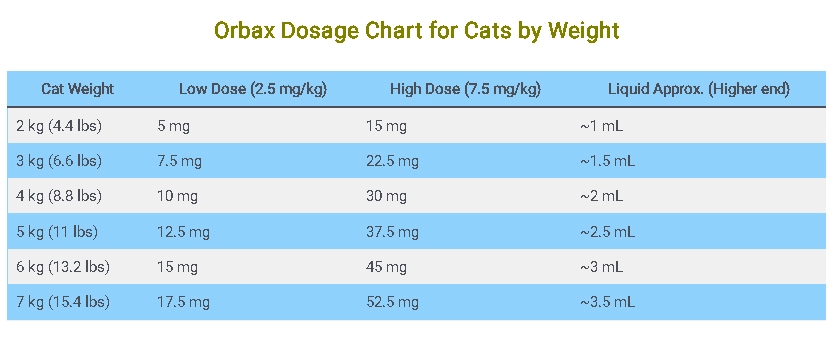
Orbax Dosage Chart for Cats by Weight
| Cat Weight | Low Dose (2.5 mg/kg) | High Dose (7.5 mg/kg) | Liquid Approx. (Higher end) |
|---|---|---|---|
| 2 kg (4.4 lbs) | 5 mg | 15 mg | ~1 mL |
| 3 kg (6.6 lbs) | 7.5 mg | 22.5 mg | ~1.5 mL |
| 4 kg (8.8 lbs) | 10 mg | 30 mg | ~2 mL |
| 5 kg (11 lbs) | 12.5 mg | 37.5 mg | ~2.5 mL |
| 6 kg (13.2 lbs) | 15 mg | 45 mg | ~3 mL |
| 7 kg (15.4 lbs) | 17.5 mg | 52.5 mg | ~3.5 mL |
Form-Specific Guidance
- Tablet form:
Usually 1–3 mg per pound of body weight - Oral suspension (liquid):
Often around 3.4 mg per pound, slightly higher due to lower absorption
Do not exceed the maximum dose of 7.5 mg/kg per day
Important Safety Note
- If no improvement is seen within 5 days, consult your vet
- Always follow your veterinarian’s exact instructions
- Do not stop treatment early to avoid antibiotic resistance
Even if your cat starts to improve, the full course must always be completed. Stopping early can cause the infection to return and may also lead to antibiotic resistance, making future treatment less effective.
How to Administer Orbax to Cats
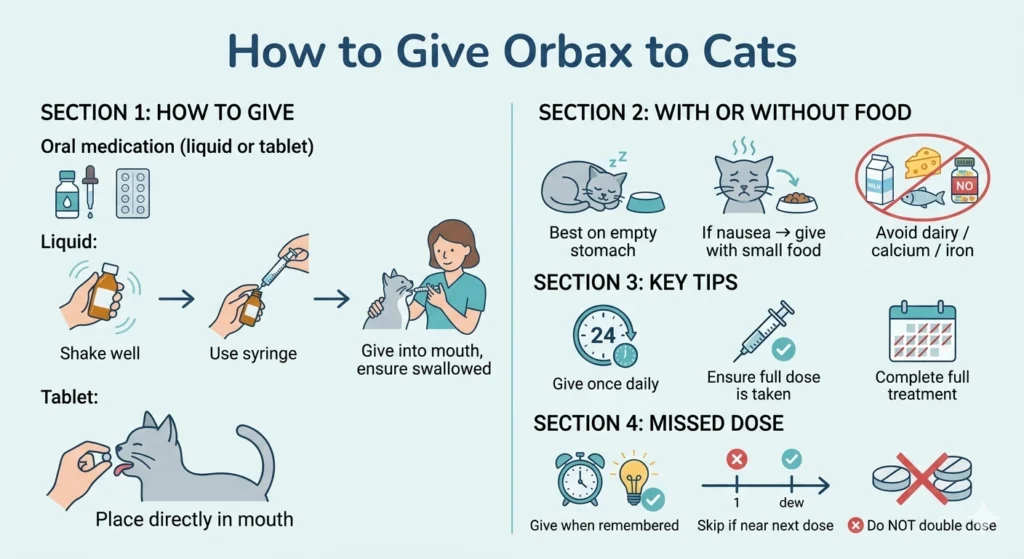
Giving orbax for cats correctly is important to ensure the medication works effectively. Orbax is given orally, either as a tablet or a liquid (oral suspension), and should always be used exactly as your veterinarian directs.
How to Give the Medication
- Liquid form:
Shake the bottle well before use and measure the dose carefully using the provided syringe. Gently lift your cat’s lip and place the medication onto the gums or into the mouth, making sure your cat swallows the full dose. - Tablet form:
Tablets are usually given directly into the mouth.
With or Without Food
- Orbax is best given on an empty stomach for proper absorption.
- If your cat shows signs of nausea or vomiting, you can give it with a small amount of food.
- Avoid foods containing calcium (like dairy products), as well as substances with aluminum, calcium, or iron, since these can reduce absorption of the medication.
Important Administration Tips
- Give the medication once daily, as prescribed.
- You can mix the liquid with a small amount of wet food if needed, but ensure your cat eats the full dose.
- Always follow your vet’s exact dosage instructions and complete the full course of treatment—even if your cat starts to feel better.
Missed Dose Instructions
If you forget a dose:
- Give it as soon as you remember, or
- Skip it if it’s close to the next scheduled dose
Do not give double or extra doses to make up for a missed one.
Side Effects of Orbax for Cats
Orbax for cats is generally well tolerated, and most cats experience few or mild side effects. However, like any medication, some reactions can occur, so it’s important to monitor your cat during treatment.
Common Side Effects
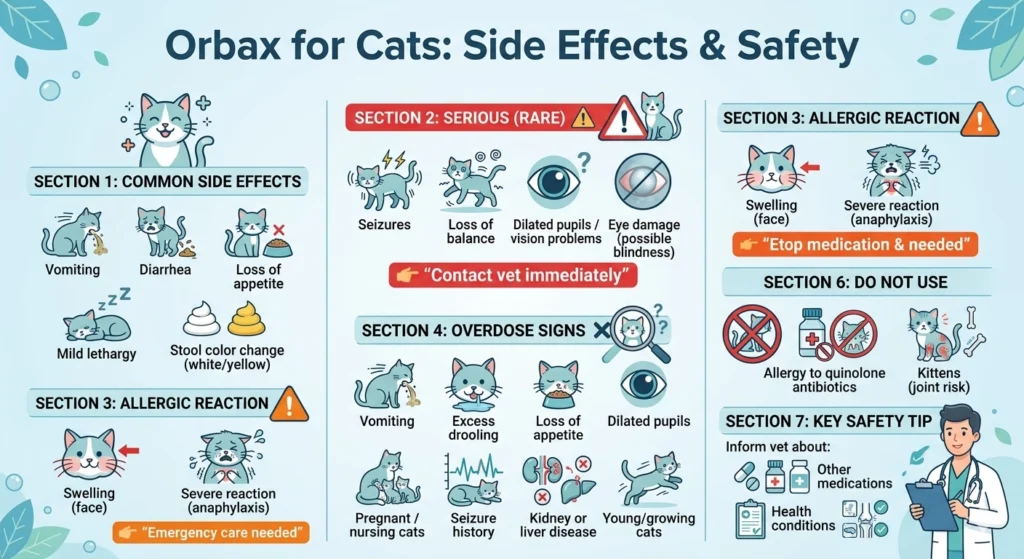
The most frequently seen side effects are related to the digestive system:
- Vomiting
- Diarrhea
- Loss of appetite
- Mild lethargy
Your cat’s feces may also appear white or yellow, which is usually not a concern and is simply an effect of the medication. These mild symptoms often resolve on their own and may improve if the medication is given with a small amount of food.
Less Common but Serious Side Effects
Although rare, more serious reactions can occur:
- Lethargy or depression
- Hypersalivation (excess drooling)
- Ataxia (loss of coordination)
- Seizures
- Loss of balance
- Enlarged pupils (mydriasis)
- Retinal changes (eye damage)
In some cases, especially at higher doses, Orbax has been associated with vision problems or blindness in cats. This may improve if the medication is stopped quickly, but it can sometimes be permanent. Immediate veterinary attention is needed if you notice changes in your cat’s eyes or vision.
Allergic Reactions
Though uncommon, cats may develop allergic reactions, including:
- Swelling (such as face swelling)
- Severe reactions like anaphylaxis
These require urgent veterinary care.
Signs of Overdose
If a cat receives too much medication, symptoms may include:
- Vomiting
- Excess salivation
- Discolored feces
- Reduced appetite or weight loss
- Dilated pupils
If you suspect an overdose, stop the medication and contact a veterinarian immediately.
When to Contact Your Vet
- If side effects are severe or long-lasting
- If your cat’s condition does not improve or worsens
- If you notice eye changes, seizures, or unusual behavior
Most side effects are not life-threatening and resolve over time or after the treatment course ends, but close monitoring is essential for your cat’s safety.
Risk Factors and When Not to Give Orbax to Cats
While orbax for cats is generally safe when prescribed correctly, some cats have a higher risk of negative reactions. It’s important to understand these risk factors and situations where this medication should be avoided.
Risk Factors in Cats
Cats may be more likely to experience side effects if they:
- Are pregnant or lactating
- Have a history of seizures
- Have kidney or liver disease
- Are young and still growing
Orbax is usually not recommended for growing cats, as it may affect joint cartilage development.
Contraindications (When Not to Give)
Orbax should not be given in the following cases:
- Cats with a known allergy to quinolone antibiotics
- Young kittens, as this medication can damage developing joint cartilage
Important Note
Always inform your veterinarian about:
- Any current medications your cat is taking
- Any known allergies or medical conditions
This helps ensure that orbax dosage for cats is safe and appropriate for your pet’s specific condition.
Drug Interactions with Orbax for Cats
When using orbax for cats, it’s very important to inform your veterinarian about all medications, supplements, or vitamins your cat is taking. Orbifloxacin can interact with several substances, which may reduce its effectiveness or increase the risk of side effects.
Medications and Substances That Interact with Orbax
Orbax may interact with:
- Antacids
- Supplements containing iron, calcium, zinc, magnesium, or aluminum
- Sucralfate
- Some antibiotics
- Warfarin (anticoagulants)
- Cimetidine
- Cyclosporine (should not be used together in cats)
- Theophylline
- Flunixin
- Methotrexate
Reduced Absorption
Substances containing calcium, iron, aluminum, magnesium, or zinc (including certain foods, supplements, and multivitamins) can reduce the absorption of Orbax.
If they must be used together, they should be given at least 2 hours apart.
Use with Caution
Special care is needed when Orbax is used alongside:
- Theophylline
- Cimetidine
- Anticoagulants (like warfarin)
Your veterinarian may adjust the dose or recommend stopping one of the medications.
Important Warning
- Do not give Orbax with oral cyclosporine in cats
- Always check with your vet before combining medications
Overdose and Emergencies
Orbax has been tested in cats at doses much higher than recommended, but overdosing can still cause serious problems.
Signs of Overdose
- Vomiting
- Loose stools or diarrhea
- Reduced appetite
- Drooling
- Soft stool with mucus
At very high doses, more serious effects such as eye damage or blindness may occur.
What to Do in an Emergency
If your cat:
- Takes too much Orbax
- Shows unusual or severe symptoms
- Becomes unwell during treatment
Contact your veterinarian immediately
Even though some cats may only show mild stomach upset, serious side effects like vision problems can occur, so quick action is essential.
How to Store Orbax
Proper storage of orbax for cats helps maintain its effectiveness and safety throughout the treatment period. Always follow the instructions on your prescription label.
Storage Guidelines
- Tablets:
Store between 36°F and 77–86°F
Keep the container tightly closed to protect from moisture and light - Oral Suspension (Liquid):
- Store upright
- Does not require refrigeration
- Keep between 36°F and 77°F
- Keep in the outer carton to protect from direct sunlight
- Shake well before use
Safety Precautions
- Keep Orbax out of reach of children and pets
- Do not use after the expiration date
- Always confirm storage instructions on the medication label
Important Considerations for Cats
Before using orbax for cats, certain precautions should be kept in mind:
- Avoid use in cats with known hypersensitivity to quinolones
- Use with caution in cats with neurological disorders or liver disease
- Safety has not been fully evaluated in pregnant, breeding, or nursing cats
- Always inform your veterinarian about other medications, vitamins, or supplements, as interactions may cause health risks
Proper storage and careful use ensure that orbax dosage for cats remains safe and effective throughout the treatment.
You May Also LIke To Read:
- Erythromycin Dosage for Cats: Chart, Safe Use & Side Effects
- Ranitidine (Zantac®) Dosage for Cats: Chart, Safe Use & Complete Guide
FAQs About Orbax for Cats
What is Orbax used for in cats?
Orbax for cats is an antibiotic used to treat bacterial infections, especially skin and soft-tissue infections like wounds and abscesses. It may sometimes be used with other antibiotics for more severe infections.
Is Orbax a good antibiotic for cats?
Orbax can be an effective option depending on the infection. Veterinarians often use culture and sensitivity testing to choose the best antibiotic. Orbifloxacin is particularly effective against Staphylococci bacteria, commonly found in skin infections.
What happens if I give my cat too much Orbax?
An overdose may cause vomiting, diarrhea, and loss of appetite. In more serious cases, high doses can lead to severe side effects such as vision problems or blindness. Contact your veterinarian immediately if an overdose is suspected.
How safe is Orbax for cats?
Orbax is generally considered safe and well tolerated in cats when used at the correct dose. Most side effects are mild, but serious reactions can occur in rare cases, so monitoring is important.
How long should Orbax be given to a cat?
The treatment duration depends on the infection, but it is usually 5 to 10 days. In some cases, treatment may continue for a short time after symptoms have resolved, as directed by your veterinarian.
How much Orbax should I give my cat?
The typical orbax dosage for cats is 2.5–7.5 mg/kg once daily, but the exact dose must always be prescribed by a veterinarian.
Can Orbax be given with food?
Orbax is best given on an empty stomach, but it can be given with a small amount of food if your cat experiences stomach upset. Avoid calcium-rich foods, as they reduce absorption.
What should I do if I miss a dose?
Give the dose when you remember, or skip it if it’s close to the next scheduled dose. Do not double the dose.
Final Thoughts
Understanding the correct orbax dosage for cats is essential to ensure your cat receives safe and effective treatment for bacterial infections. Orbax for cats, containing orbifloxacin, is a powerful antibiotic that works well when used properly under veterinary guidance.
From knowing what Orbax is, how it works, and its common uses, to learning the correct dosage, administration, and possible side effects—each step plays an important role in your cat’s recovery. Following your veterinarian’s instructions carefully, giving the medication exactly as prescribed, and completing the full course are all key to preventing complications and ensuring the infection is fully cleared.
Always monitor your cat during treatment and contact your veterinarian if you notice any unusual symptoms or if your cat does not improve as expected. When used responsibly, orbax for cats can be a reliable and effective option to help your cat return to good health.