Seeing your cat have a seizure can be very scary. Seizures in cats, often caused by epilepsy or other brain issues, need proper management. Phenobarbital is a common veterinary medication that helps reduce the frequency and severity of seizures, making them more manageable.
While it may not completely stop seizures, phenobarbital helps cats live a safer and more comfortable life.
In this guide, you’ll Learn the safe and effective phenobarbital dosage for cats, including oral tablets, liquid, and transdermal options. Discover how to give the medication, monitor side effects, and ensure proper seizure management for your feline companion.
Disclaimer: This content is for informational purposes only and should not replace veterinary advice. Always consult your veterinarian before giving Phenobarbital or adjusting your cat’s dosage.


Key Takeaways: Phenobarbital Dosage for Cats
- Phenobarbital is a first-choice anti-seizure medication for cats, primarily used to reduce the frequency and severity of seizures caused by epilepsy or brain conditions.
- Typical starting dose is 2–2.5 mg per kg every 12 hours; dosing may vary based on your cat’s weight and response to treatment.
- Multiple administration forms are available: tablets, oral liquid, paste, chewable, and compounded transdermal gel applied to the ear flap for cats who resist oral medication.
- Consistency is crucial: do not skip doses, and never stop abruptly; doses must be tapered under veterinary guidance.
- Side effects may include sedation, incoordination, increased thirst, urination, and appetite changes. Serious risks include respiratory depression and rare blood abnormalities.
- Drug interactions can occur with benzodiazepines, opioids, alpha-2 agonists, antihistamines, antibiotics, and antifungals; always inform your veterinarian of all medications your cat is taking.
- Monitoring is essential: regular blood tests help track liver function and ensure safe long-term use.
- Transdermal phenobarbital and oral liquid formulations offer convenient alternatives for cats who resist tablets.
- Full effectiveness may take 1–2 weeks, though gradual improvements are often noticed sooner.
- Veterinary guidance is key: individualized dosing and monitoring are critical for safe and effective seizure management.
What is Phenobarbital?
Phenobarbital is a barbiturate medication commonly used in veterinary medicine to manage seizures in cats. It works by calming overactive brain signals, which helps reduce the frequency and severity of epileptic episodes.
While phenobarbital is approved for controlling seizures in some animals, its use in cats is often considered off-label, meaning it is prescribed specifically for feline seizure management even if not explicitly listed on the label.
Off-label use is common in veterinary care, but it requires careful attention to your veterinarian’s instructions, as dosing and administration can differ from the standard guidelines.
Phenobarbital is available under several brand names, including Nobatol®, Luminal Sodium®, Solfoton®, and Tedral®, and may sometimes be used as a mild sedative in cats under veterinary guidance.


Key Points for Cat Owners:
- Phenobarbital is primarily used to control seizures in cats, including epilepsy and other seizure disorders.
- Its use in cats is often off-label, so always follow your veterinarian’s directions carefully.
- Helps make seizures less frequent and less severe, improving your cat’s quality of life.
- Brand names include Nobatol®, Luminal Sodium®, Solfoton®, and Tedral®.
What is Phenobarbital for Cats, and How Does It Work?
Phenobarbital for cats is mainly used to reduce the frequency of seizures, especially in cats with conditions like epilepsy and brain tumors. It is considered a first-choice treatment for managing seizures in cats.
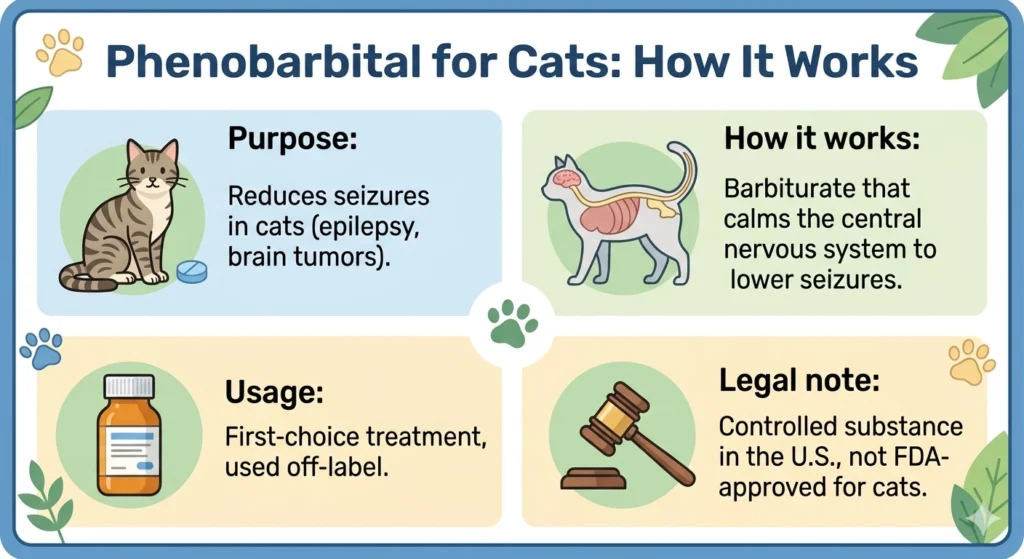
It belongs to a class of drugs called barbiturates, which work by depressing the central nervous system (brain and spinal cord). This helps reduce seizure activity.
Phenobarbital is not FDA-approved for cats, so its use is considered off-label (extra-label). This is common in veterinary medicine. It is also a controlled substance in the U.S., meaning there may be extra restrictions when prescribed.
Uses of Phenobarbital
Phenobarbital is a widely used medication for managing seizures in cats, helping control seizure activity and improve overall quality of life. It is also used to treat seizures caused by structural brain disease.
While phenobarbital is considered a cost-effective and highly effective option compared to alternatives like imepitoin, it remains a commonly utilized treatment for seizure control across veterinary medicine.
In addition to its primary use for seizures, phenobarbital is also used in combination with other treatments, such as propranolol and behavior modification, in certain cases to manage conditions influenced by physiological factors, although this use is more commonly applied in dogs.
Phenobarbital Dosage for Cats
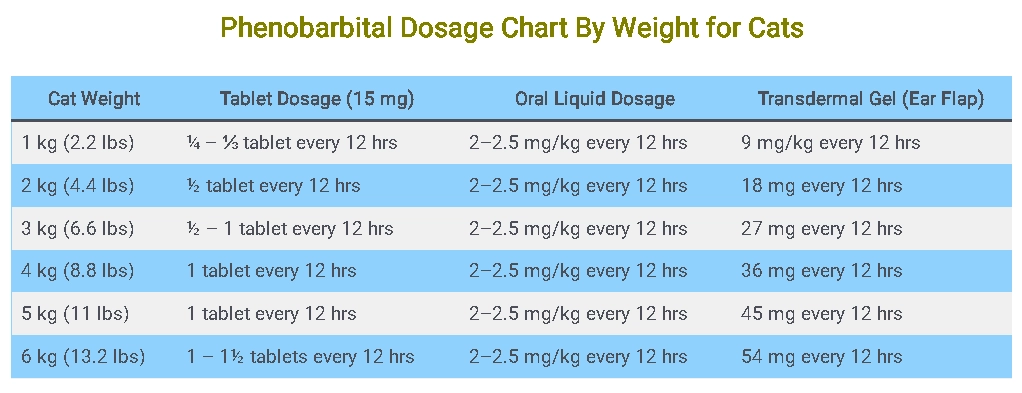
The typical starting safe Phenobarbital dosage for cats with epilepsy is 2–2.5 Phenobarbital mg per kg for cat of body weight every 12 hours, This usually means either ½ or 1 whole 15 mg tablet by mouth every 12 hours. For cats that have difficulty taking oral medication, phenobarbital can be compounded into an oral liquid using the same dosage. A transdermal form applied inside the ear flap is sometimes used at 9 mg per kilogram every 12 hours, though more studies are needed to confirm its effectiveness. In clinical settings, phenobarbital may also be administered as an injection, often alongside benzodiazepines, to control active seizures.
Essential Notes on Dosage:
- Full effect may take a few weeks
- Gradual improvement is often seen after a few doses
- Doses must be consistent; never skip
Phenobarbital Dosage Chart By Weight for Cats
| Cat Weight | Tablet Dosage (15 mg) | Oral Liquid Dosage | Transdermal Gel (Ear Flap) |
|---|---|---|---|
| 1 kg (2.2 lbs) | ¼ – ⅓ tablet every 12 hrs | 2–2.5 mg/kg every 12 hrs | 9 mg/kg every 12 hrs |
| 2 kg (4.4 lbs) | ½ tablet every 12 hrs | 2–2.5 mg/kg every 12 hrs | 18 mg every 12 hrs |
| 3 kg (6.6 lbs) | ½ – 1 tablet every 12 hrs | 2–2.5 mg/kg every 12 hrs | 27 mg every 12 hrs |
| 4 kg (8.8 lbs) | 1 tablet every 12 hrs | 2–2.5 mg/kg every 12 hrs | 36 mg every 12 hrs |
| 5 kg (11 lbs) | 1 tablet every 12 hrs | 2–2.5 mg/kg every 12 hrs | 45 mg every 12 hrs |
| 6 kg (13.2 lbs) | 1 – 1½ tablets every 12 hrs | 2–2.5 mg/kg every 12 hrs | 54 mg every 12 hrs |
Notes:
- Oral liquid doses are equivalent to tablet doses, calculated based on 2–2.5 mg per kg every 12 hours.
- Transdermal gel is applied inside the ear flap every 12 hours and is usually reserved for cats that resist oral medication.
- Phenobarbital should be given consistently at the same times daily, and doses should not be skipped or doubled.
- Full effects may take 1–2 weeks; monitoring blood levels and liver function is recommended.
- Injectable phenobarbital may be used in clinics for active seizures, usually in combination with benzodiazepines.
How much phenobarbital to give a cat
Phenobarbital can be administered in several forms, depending on your cat’s needs:
- By mouth: tablet, capsule, liquid syrup, paste, or chewable
- Injection: in clinic for active seizure control
- Transdermal gel: applied to the inside of the ear for cats that resist oral medication
Practical Guidelines:
- May be given with or without food
- If vomiting occurs on an empty stomach, give with food or a treat
- Medication must be given regularly and not stopped abruptly; it should be tapered slowly under veterinary guidance
What Are the Phenobarbital side effects in cats?
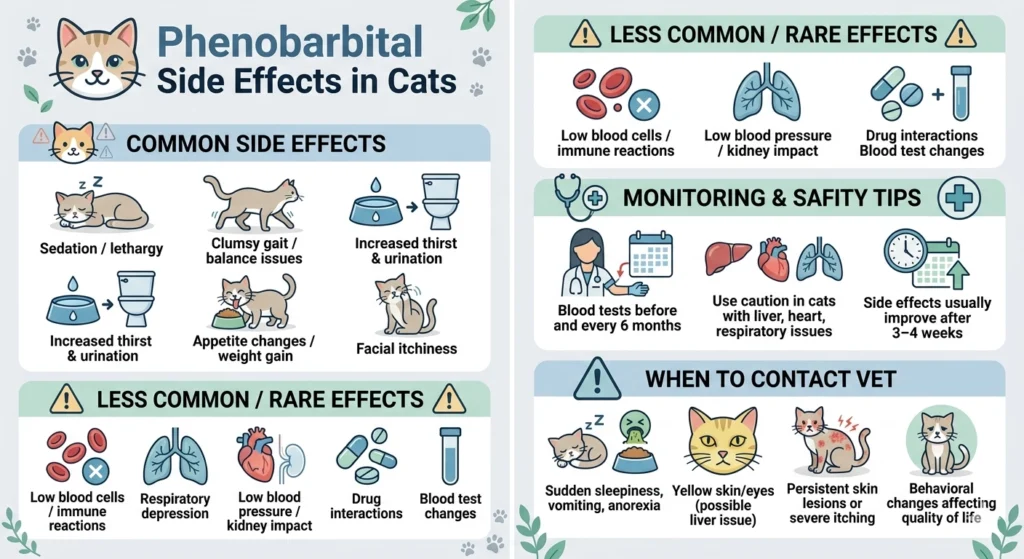
Phenobarbital is generally well-tolerated in cats, but like all medications, it can cause side effects. Many cats experience only mild or temporary effects, especially during the first few weeks of treatment.
Common Side Effects
- Sedation or lethargy – cats may appear sleepy or less active
- Clumsy gait or balance issues – incoordination is common initially
- Increased thirst and urination
- Changes in appetite – often increased, which can lead to weight gain
- Facial itchiness – mild irritation around the face and head
Less Common or Rare Side Effects
- Reduced blood cell counts (immune-mediated reactions)
- Respiratory depression – mainly at higher doses due to central nervous system depression
- Hypotension (low blood pressure) – may affect kidney function in sensitive cats
- Drug interactions – phenobarbital can interact with other medications like mirtazapine, dexmedetomidine, buprenorphine, and antihistamines
- Effects on blood tests – can alter thyroid and Cushing’s test results
Monitoring and Safety Tips
- Blood tests are recommended before starting and at least every six months to monitor liver function, red blood cells, and overall health
- Use with caution in cats with liver disease, dehydration, anemia, heart, or respiratory problems
- Most side effects improve after 3–4 weeks of regular dosing
- In overdose situations, lethargy, sedation, and severe incoordination are the main signs
When to Contact Your Veterinarian
- Sudden excessive sleepiness, vomiting, or anorexia
- Yellowing of the skin or eyes (possible liver dysfunction)
- Persistent skin lesions, sores, or severe itching
- Any behavioral changes that interfere with your cat’s quality of life
What Are the Most Serious Risks of Phenobarbital for Cats?
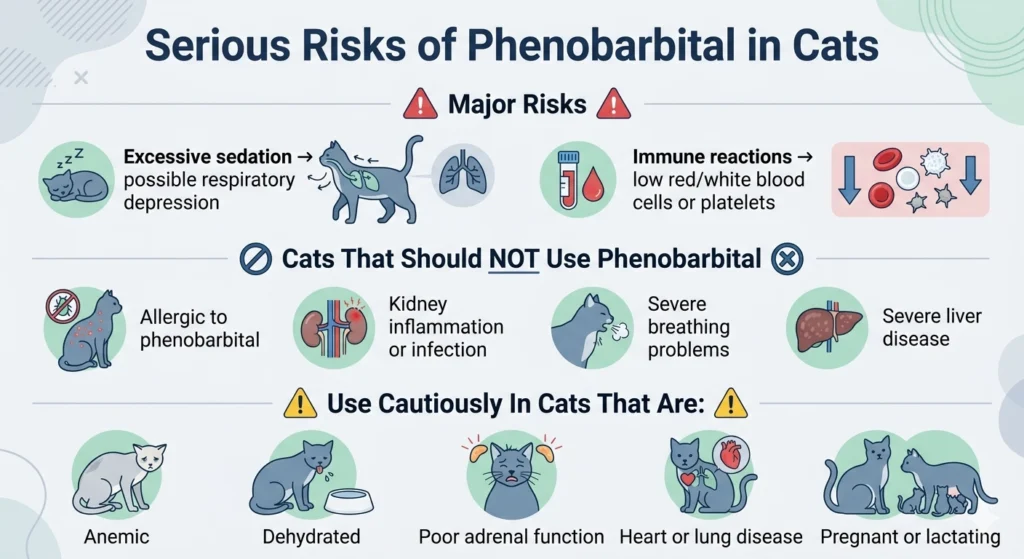
While phenobarbital is effective for managing seizures in cats, there are serious risks that owners should be aware of.
Major Risks
- Excessive sedation: in some cats, this can lead to respiratory depression (slow or difficult breathing)
- Immune reactions: rare cases can cause low red blood cell, white blood cell, or platelet counts, affecting overall health
Cats That Should NOT Use Phenobarbital
- Cats allergic to phenobarbital
- Cats with kidney inflammation or infection
- Cats with severe breathing problems
- Cats with severe liver disease
Use Cautiously in Cats That Are:
- Anemic
- Dehydrated
- Have poor adrenal function
- Have heart or lung disease
- Pregnant or lactating
Does Phenobarbital Interact with Other Cat Medications?
Phenobarbital can interact with several medications commonly used in cats. These include:
- Alpha-2 agonists – e.g., dexmedetomidine
- Antibiotics – e.g., clindamycin, doxycycline
- Antifungals – e.g., itraconazole
- Antihistamines – e.g., diphenhydramine
- Benzodiazepines – e.g., diazepam, midazolam
- Opioids – e.g., buprenorphine
If your cat is taking any of these medications, your veterinarian will carefully weigh the risks versus benefits before prescribing phenobarbital. Always inform your veterinarian of all medications and supplements your cat is currently receiving to ensure safety.
What Should You Do If Your Cat Misses a Dose of Phenobarbital?
If your cat misses a dose of phenobarbital, the first step is to contact your veterinarian for guidance.
- If it’s not too long since the missed dose, your veterinarian may advise giving it as soon as possible.
- If it’s almost time for the next dose, they may recommend skipping the missed dose and returning to the regular schedule.
- Do not give a double dose, as this can increase the risk of side effects.
- If your cat experiences a seizure due to a missed dose, contact your veterinarian immediately.
How Do I Store Phenobarbital?
Proper storage of phenobarbital is essential to ensure safety and effectiveness.
- Keep tablets and liquid medication at room temperature between 15°C and 30°C (59°F to 86°F).
- Store protected from light and moisture.
- Because phenobarbital is a controlled substance, it should be kept in a locked cabinet or safe with access limited to those administering it.
- Monitor the amount of medication regularly to ensure none is missing, as controlled substances have a risk of diversion and it is illegal to use this medication for anyone or any animal other than the prescribed patient.
You May Also Like To Read:
FAQs
What happens when I forget to administer a dose of phenobarbital to my cat?
Take the missed dose immediately after remembering except when it is almost time to take the next schedule dose.
Do not administer two doses concurrently or additional doses.
Return to the regular dosing schedule.
What are the first things I need to know in case of an emergency?
In case of overdose or any other negative reaction, contact your veterinarian.
In case the vet is unavailable, go as per their instructions on how to contact an emergency veterinary facility.
Phenobarbital How long does phenobarbital take to work in cats?
Orally: The peak action may take place 4-12 hours following the administration.
Complete efficacy: 1 to 2 weeks, but improvement can be observed earlier.
It can be several weeks before the levels of blood serum stabilize with or without changing the dose.
Does phenobarbital provide a safe long-term use in cats?
Yes, it can be safely used as a long-term anticonvulsant with a constant check of liver health and blood levels of phenobarbital.
What is the effect of phenobarbital in cats?
Phenobarbital is an anti-seizure agent that is mainly used to increase the seizure threshold and decrease the frequency of seizures.
It is a central nervous system depressant (CNS).
CNS depression can result in sedation, lethargy, respiratory depression, or low blood pressure at higher doses, an issue that emphasizes the need to properly dose the veterinary patient.
Do natural alternatives to support cats on phenobarbital exist?
Certain supplements, such as cannabidiol, or herbal sedatives, can be supportive.
They are not alternative to phenobarbital and they must be administered only when approved by the veterinarian.
Final Thoughts
Phenobarbital is a first-choice, long-standing treatment for controlling seizures in cats. It is typically very effective, widely used, and cost-efficient, helping many cats maintain a better quality of life despite epilepsy or other seizure disorders.
While generally safe, monitoring for side effects is important, especially during the first few weeks. Common effects include lethargy, increased appetite, excessive drinking, urination changes, and mild clumsiness, which often improve over time.
Side effects can be more pronounced if phenobarbital is combined with other anti-seizure medications, sedatives, anesthetics, or pain medications.
Regular blood work and veterinary monitoring are essential, as phenobarbital can interact with other medications and may require dose adjustments. Always consult your veterinarian about your cat’s medical history, other medications, and the safest dosing approach.
Never adjust doses on your own or use medications prescribed for humans without veterinary guidance.
With proper use, monitoring, and support, phenobarbital can transform seizure management from a stressful diagnosis into a manageable condition, giving your cat stability and improving overall well-being.
Partnering closely with your veterinarian ensures the best, personalized care for your feline friend.