Cats often don’t drink enough water, which makes them more likely to become dehydrated—especially when they are sick, eating dry food, or experiencing vomiting or diarrhea. Unlike other animals, cats naturally have a low thirst drive, so hydration problems can happen quickly.
In some cases, pet owners use Pedialyte, an electrolyte solution, to help restore lost fluids and support hydration in cats. While it can be helpful, it’s important to use the correct Pedialyte dosage for cats and understand when it is safe to give.
In this guide, you’ll Learn the correct Pedialyte dosage for cats, including safe amounts, how to give it, benefits, risks, and when to seek veterinary care.
Disclaimer: This content is for informational purposes only and should not replace veterinary advice. Always consult your veterinarian before giving Pedialyte or adjusting your cat’s dosage.
Key Takeaways
- Pedialyte helps cats stay hydrated by replacing lost fluids and essential electrolytes, especially during vomiting, diarrhea, or low water intake.
- Unflavored, classic Pedialyte is the safest choice for cats; flavored or high-sugar varieties can worsen diarrhea.
- Dosage must be small and controlled, depending on the cat’s size, age, and hydration status. Always consult a veterinarian for guidance.
- Administration matters: Use a syringe or dropper, give slowly, and let the cat swallow naturally to avoid aspiration.
- Not a substitute for veterinary care: Pedialyte is only for mild dehydration or short-term support. Severe or persistent symptoms require professional evaluation.
- Electrolytes are critical: Sodium, potassium, and chloride support muscle function, nerve signals, and fluid balance in cats.
- Monitor your cat: Stop Pedialyte if vomiting, diarrhea, lethargy, or behavioral changes occur, and seek veterinary care immediately if serious symptoms appear.
- Difference from sports drinks: Pedialyte has lower sugar content and is designed for rehydration due to fluid loss, not for energy replacement like Gatorade or Powerade.
About Pedialyte for Cats
Pedialyte is an over-the-counter oral rehydration solution commonly used to help prevent dehydration and restore lost fluids. It contains essential electrolytes like sodium, potassium, and chloride, which are important for maintaining proper hydration—especially when fluid loss occurs due to vomiting or diarrhea.
Although Pedialyte is made for humans, it can also be used for cats in certain situations. Cats can lose fluids quickly when they are sick, and in mild cases of dehydration, Pedialyte may help replenish electrolytes and support hydration when used carefully.
Pedialyte is available in different forms, including a ready-to-use liquid (usually in 1-liter bottles) and a powder that can be mixed with water. There are also different varieties designed for sports or immune support, but these are not ideal for cats.
For feline use, most veterinary experts recommend using unflavored, classic Pedialyte only, as flavored versions may contain ingredients that are not suitable for cats.
It’s important to remember that Pedialyte should be used in moderation and only for mild conditions, and it should never replace proper veterinary care if your cat’s condition is serious.
What Does Pedialyte Do for Cats?
Pedialyte helps replace lost fluids and electrolytes in cats, making it useful in mild cases of dehydration, especially when caused by vomiting, diarrhea, or reduced food and water intake. The main goal of using Pedialyte is to prevent dehydration or support recovery from mild fluid loss.
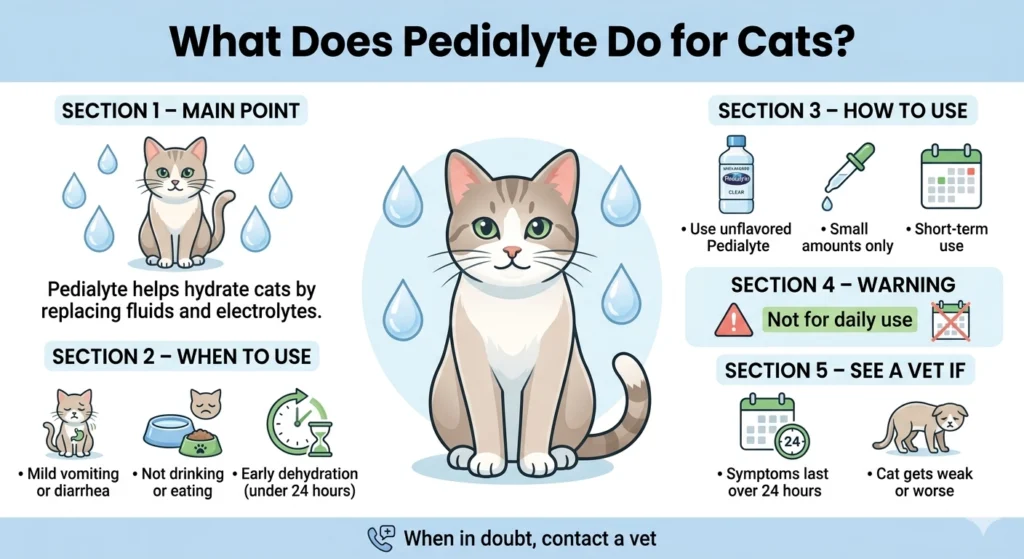
It should only be used in moderation and for short-term support. Most experts recommend using unflavored, classic Pedialyte (typically the standard 1-liter bottle), as it is the safest option for cats.
Pedialyte is most appropriate for:
- Mild stomach upset (vomiting or diarrhea)
- Temporary loss of appetite or low water intake
- Early or mild dehydration lasting less than 12–24 hours
However, Pedialyte is not meant for regular use or daily supplementation.
If your cat shows signs of moderate to severe dehydration or symptoms last longer than 24 hours, Pedialyte alone is not enough. In these cases, veterinary care is necessary.
While giving fluids at home may seem easier, treatments provided by a veterinarian are much more effective. Injectable fluids (especially subcutaneous fluids) are absorbed faster and more completely by the cat’s body. In many cases, vets can give fluids under the skin in about 10–15 minutes, without needing an IV.
Understanding Pedialyte’s Role for Cats
Pedialyte is an electrolyte solution originally made for humans, but it can also help support hydration in cats when used correctly. Cats can become dehydrated quickly, especially during illnesses like vomiting, diarrhea, or kidney problems.
Unlike plain water, Pedialyte contains important electrolytes such as sodium, potassium, and chloride, which help maintain fluid balance and normal body function. This makes it useful for restoring hydration and supporting recovery in mild cases of dehydration.
However, Pedialyte is not a cure and should never replace veterinary care. It is only a supportive option for short-term use when dehydration is mild or while waiting for professional treatment. For safety, it should always be given in proper amounts and only in unflavored form, without added sugars or sweeteners.
Why Cats Need Electrolytes
lectrolytes are essential minerals that help control muscle function, nerve signals, and fluid balance in a cat’s body. When a cat becomes dehydrated, these electrolytes can drop to unhealthy levels, leading to symptoms like weakness, lethargy, and more serious health problems if not corrected.
Common reasons cats lose electrolytes include:
- Vomiting and diarrhea – cause rapid loss of fluids and electrolytes
- Kidney disease – affects the body’s ability to regulate fluids
- Heat stress – leads to fluid loss through panting or paws
- Low water intake – common in cats and worsens during illness
Water alone can help with hydration, but it does not replace lost electrolytes. Pedialyte helps by providing both fluids and essential minerals, making it useful for restoring balance when used safely and in the correct dosage.
Potential Benefits of Pedialyte for Cats
Pedialyte can help support cats dealing with mild dehydration, especially when caused by conditions like vomiting, diarrhea, or reduced water intake. Its electrolyte-rich formula works to restore fluids and essential minerals, helping the body recover more effectively.
Here are the main benefits of Pedialyte for cats:
- Rehydration: Helps replace fluids lost due to vomiting, diarrhea, or not drinking enough water
- Electrolyte Replenishment: Restores important minerals like sodium, potassium, and chloride
- Support During Illness: Helps maintain hydration and electrolyte balance while your cat recovers
While Pedialyte can be helpful, it must be used carefully and in the correct dosage. It is not a replacement for veterinary care and should ideally be used under a veterinarian’s guidance, especially if your cat’s condition does not improve.
Pedialyte for Cats Dosage
There is no officially established dosage of Pedialyte for cats, so it’s always best to consult a veterinarian before giving it at home. The right amount depends on your cat’s age, weight, health, and severity of dehydration. Pedialyte should only be used for mild dehydration or short-term fluid loss (vomiting, diarrhea, or low water intake lasting less than 12–24 hours).
Guidelines for Adult Cats and Larger Kittens (≥5 pounds)
- If your cat is drinking on their own:
- Mix 1 teaspoon of Pedialyte with 3–4 tablespoons of water in a bowl.
- Adding a small amount of tuna juice can improve taste.
- Offer this mixture every hour while monitoring fluid intake, with plain water available in between.
- If your cat is not drinking voluntarily:
- Use a small oral syringe (no needle) to administer 1–2 ml (¼–½ teaspoon) at a time, no more than once per hour.
- Direct fluid into the cheek pouch or front of the mouth, allowing the cat to swallow naturally.
- Administer in ½–1 ml increments to reduce the risk of aspiration, which can be dangerous.
Guidelines for Kittens
- Neonatal kittens (milk-fed):
- Mix a small amount of Pedialyte with kitten milk replacer (KMR), not exceeding ⅛–¼ of the total volume.
- Pedialyte can be offered in free-feeding bowls or via syringe/dropper, a few drops every 30–60 minutes.
- Non-neonatal kittens (<5 pounds):
- Aim for ½–1 ml per hour, depending on tolerance and weight.
General Safe Dosage Guidelines
- Small cats or kittens: ~5 ml per dose every 4–6 hours
- Larger adult cats: up to 10 ml per dose every 4–6 hours
- Always use small, controlled amounts to prevent discomfort, vomiting, or complications.
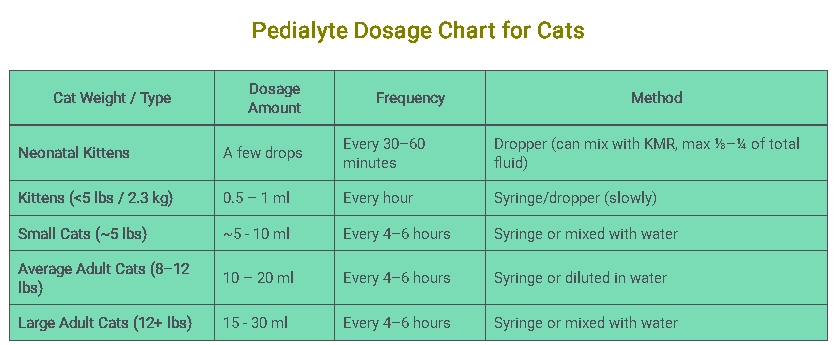
Pedialyte Dosage Chart for Cats
| Cat Weight / Type | Dosage Amount | Frequency | Method |
|---|---|---|---|
| Neonatal Kittens | A few drops | Every 30–60 minutes | Dropper (can mix with KMR, max ⅛–¼ of total fluid) |
| Kittens (<5 lbs / 2.3 kg) | 0.5 – 1 ml | Every hour | Syringe/dropper (slowly) |
| Small Cats (~5 lbs) | ~5 – 10 ml | Every 4–6 hours | Syringe or mixed with water |
| Average Adult Cats (8–12 lbs) | 10 – 20 ml | Every 4–6 hours | Syringe or diluted in water |
| Large Adult Cats (12+ lbs) | 15 – 30 ml | Every 4–6 hours | Syringe or mixed with water |
Important Notes
- Use unflavored Pedialyte only
- Always give small, controlled amounts
- Do not force large volumes (risk of aspiration)
- Provide fresh water alongside
- Use only for mild dehydration (under 24 hours)
- Consult a veterinarian for exact dosing and if symptoms persist
How to Administer Pedialyte Correctly
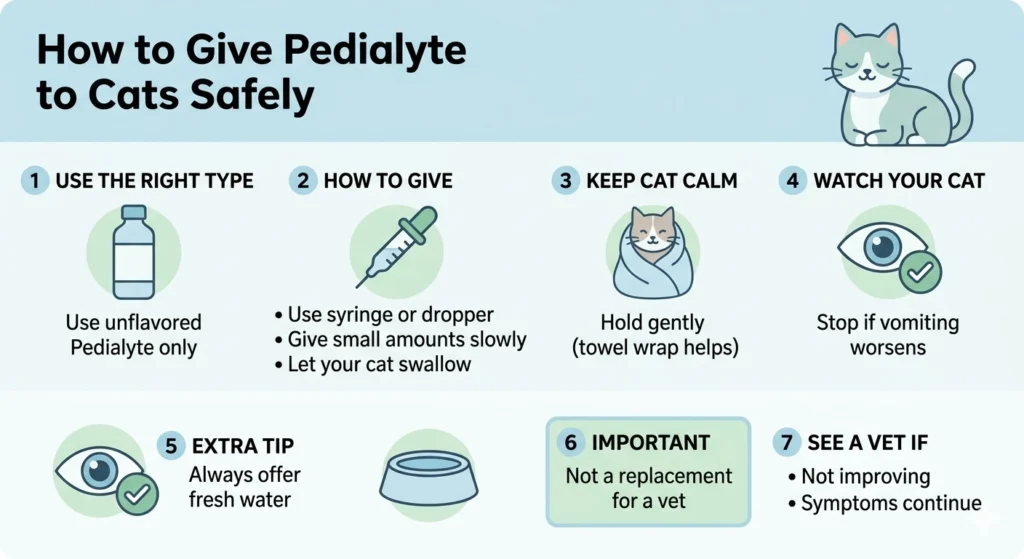
- Use unflavored Pedialyte – avoid artificial sweeteners, colors, or flavors that can be toxic to cats.
- Use an oral syringe or dropper – allows controlled dosing and reduces spills.
- Position your cat comfortably – wrapping in a towel can help calm squirming pets.
- Administer slowly in small amounts – let your cat swallow before giving more.
- Monitor tolerance – stop if vomiting increases and consult your vet.
- Offer fresh water alongside Pedialyte to encourage voluntary drinking.
Key Reminder: Pedialyte is supportive care only. It is not a replacement for veterinary treatment, especially in cases of severe dehydration, persistent vomiting/diarrhea, or underlying illness.
Side Effects and Risks of Pedialyte for Cats
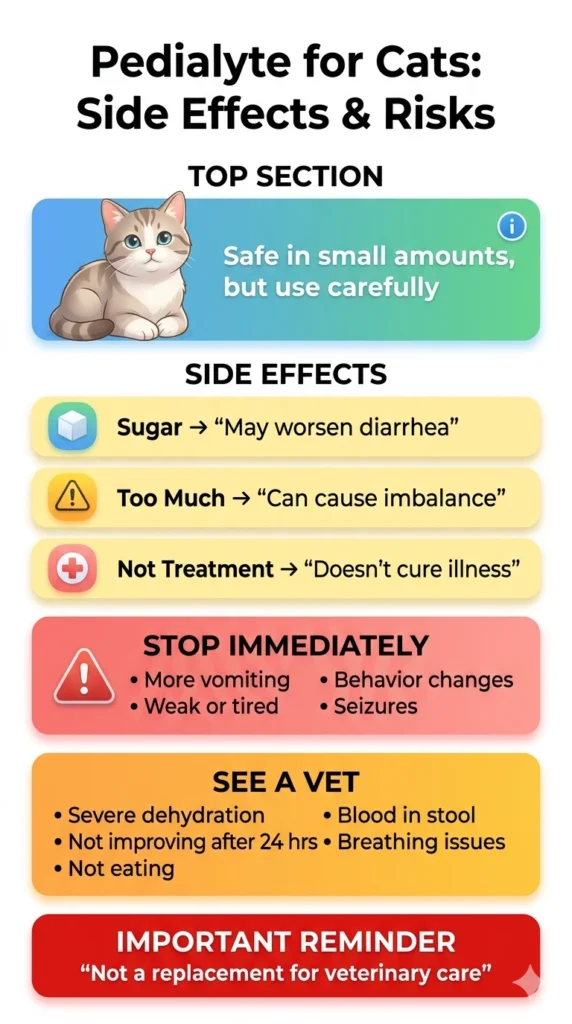
When used in moderation, Pedialyte is generally safe for cats. However, it is not specifically labeled for feline use, so it’s important to check with your veterinarian before giving it to your cat, especially if your cat has pre-existing medical conditions.
Potential Side Effects
- High Sugar Content: Flavored or sweetened Pedialyte can worsen diarrhea, which is why unflavored classic Pedialyte is recommended.
- Electrolyte Imbalance: Giving too much Pedialyte may disrupt electrolyte levels, potentially causing serious complications.
- Zinc Concerns: Some worry about zinc content, but classic Pedialyte contains only 2.8 mg per 12 ounces, far below toxic levels for cats. Following proper dosing guidelines keeps zinc exposure safe.
- Underlying Conditions: Pedialyte helps with dehydration but does not treat the root cause of illness. Persistent symptoms may indicate a more serious problem.
Signs to Stop Pedialyte and Call a Vet
If you notice any of these, discontinue Pedialyte immediately and contact your veterinarian:
- Increased vomiting or diarrhea
- Lethargy or weakness
- Behavioral changes
- Seizures
When to Seek Veterinary Care
Pedialyte is supportive care only and not a replacement for professional treatment. Seek veterinary help if your cat has:
- Severe dehydration
- Persistent vomiting or diarrhea
- Lethargy or weakness
- Loss of appetite for more than 24 hours
- Blood in vomit or stool
- Difficulty breathing
A veterinarian can assess your cat’s condition, determine the appropriate dosage of Pedialyte if needed, and recommend a treatment plan to address the underlying cause. Delaying professional care can worsen your cat’s condition and lead to serious complications.
What are the risks of giving Pedialyte to cats?
While Pedialyte can help with mild dehydration, there are risks:
- Electrolyte imbalance: Too much Pedialyte can upset a cat’s delicate electrolyte balance, potentially causing hypernatremia (high sodium) or hypokalemia (low potassium).
- Nutritional insufficiency: Pedialyte does not provide essential nutrients cats need during illness.
- Delayed treatment: Relying on Pedialyte alone may delay diagnosis and treatment of the underlying problem.
Because of these risks, use Pedialyte only with veterinary guidance and monitor your cat closely.
What Is the Difference Between Pedialyte and Sports Drinks?
Pedialyte is different from sports drinks like Gatorade or Powerade in sugar content and purpose. While Pedialyte contains some sugar, it is much lower than typical sports drinks.
Sports drinks are designed for humans to replenish fluids and provide energy during exercise, whereas Pedialyte is intended for rehydration after fluid loss caused by vomiting, diarrhea, or illness.
Using a product with high sugar content can worsen diarrhea in cats by causing the digestive system to release more fluids and electrolytes. This is why unflavored, low-sugar Pedialyte is the safest option for cats when addressing dehydration.
You May Also Like To REad:
FAQs
Can you give Pedialyte to cats?
Yes, plain, unflavored Pedialyte can help dehydrated cats drink fluids. Give small amounts, ideally mixed with water, wet food, or a small amount of tuna or clam juice. Some cats enjoy frozen Pedialyte ice cubes as a fun way to hydrate. Pedialyte is useful for minor dehydration, but if your cat refuses to drink, is lethargic, or has persistent vomiting or diarrhea, seek veterinary care immediately.
Can Pedialyte be used as a substitute for veterinary care?
No. Pedialyte does not treat the underlying cause of dehydration or illness. Cats with vomiting, diarrhea, or refusal to eat or drink require a veterinarian’s evaluation. Professional treatment may include fluid therapy, medications, or dietary adjustments. Pedialyte is supportive only and should never replace proper veterinary care.
What are the alternatives to Pedialyte for cats?
Veterinary-specific electrolyte solutions, like Rebound Recuperation Formula, or vet-recommended homemade electrolyte solutions are safer and tailored for cats. Always consult your veterinarian before administering any electrolyte solution.
Can I use Pedialyte for kittens?
Caution is required. Only use Pedialyte for kittens if specifically directed by a veterinarian. Otherwise, use kitten-specific electrolyte or oral rehydration solutions. Dosage adjustments are critical for kittens to avoid complications.
What flavors of Pedialyte are safe for cats?
Unflavored Pedialyte is safest. Flavored varieties may contain xylitol or other additives that are toxic to cats. Always check ingredients and dilute even the unflavored version.
How often can I give my cat Pedialyte?
Frequency depends on your cat’s condition and veterinary guidance. Typically, small doses every 2–4 hours are safe. Monitor your cat and adjust based on tolerance and response.
Can Pedialyte cure my cat’s diarrhea?
No. Pedialyte replaces lost fluids and electrolytes but does not treat diarrhea. Diarrhea may have various causes, such as infections, parasites, or dietary issues, which require veterinary diagnosis.
What are the signs of overhydration in cats?
Excessive fluid intake can cause hyponatremia (low sodium). Signs include:
Vomiting or diarrhea
Lethargy
Dilated pupils
Seizures in severe cases
Contact your veterinarian immediately if you suspect overhydration.
Is it safe to give my cat Pedialyte long-term?
Long-term use is not recommended unless directed by a veterinarian. Electrolyte solutions should support treatment of the underlying cause, not replace it. Always follow your veterinarian’s guidance for ongoing management.
Final Thoughts
Pedialyte can be a helpful tool for supporting hydration in cats, especially during mild cases of vomiting, diarrhea, or reduced water intake. It works by replacing lost fluids and essential electrolytes like sodium, potassium, and chloride, helping your cat recover more comfortably.
However, Pedialyte is not a cure and should never replace veterinary care. Proper dosing, using unflavored Pedialyte, and careful administration are essential to keep your cat safe and avoid complications.
Always monitor your cat closely while giving Pedialyte, and seek professional help if dehydration is severe, symptoms persist, or your cat shows signs of illness. When used correctly, Pedialyte can provide temporary support, giving your cat a boost in hydration while you ensure they receive the care they need.
Remember: Hydration is critical for your cat’s health, and Pedialyte should be used as a short-term supportive measure, not a daily supplement.