
If your cat is suffering from diarrhea, stomach infections or parasites, Metronidazole is a commonly prescribed medication that can help. Also known by the brand name of Flagyl, it is an antibiotic and antiprotozoal drug used to treat infections of the digestive tract, inflammation and parasites such as Giardia in the cat.
Metronidazole is normally administered as an oral drug, but in severe situations, veterinarians may administer it as an injection. While this is not approved by the FDA for use in pets, vets safely use it as an off-label treatment due to its effectiveness.
Understanding Metronidazole dosage for cats is very important with the wrong dosage of medicine can cause serious side effects. In this guide, you’ll learn everything from proper dosage, uses, benefits, and some tips for keeping your cat safe and healthy.
Learn the correct Metronidazole dosage for cats, including safe dosing ranges, uses, side effects, and vet-approved guidelines for treating diarrhea and infections.
Disclaimer: This content is for informational purposes only and should not replace veterinary advice. Always consult your veterinarian before giving Metronidazole or adjusting your cat’s dosage.


Key Takeaways: Metronidazole Dosage for Cats
- Metronidazole (Flagyl) is a widely used antibiotic and antiprotozoal medication prescribed by veterinarians to treat diarrhea, inflammatory bowel disease (IBD), and infections in cats.
- It works by targeting specific bacteria and protozoa parasites, especially those affecting the digestive (gastrointestinal) tract.
- Although effective, Metronidazole is not FDA-approved for animal use; however, vets can legally prescribe it as an extra-label (off-label) medication.
- Correct dosage and proper administration are critical to ensure safety and effectiveness—always follow your veterinarian’s instructions closely.
- Side effects can occur, with diarrhea being the most common, even though the drug is often used to treat it.
- Long-term or improper use can lead to serious side effects, including behavior changes and seizures, making careful monitoring essential.
- Understanding both the benefits and potential risks of Metronidazole is important for responsible cat care and safe treatment.
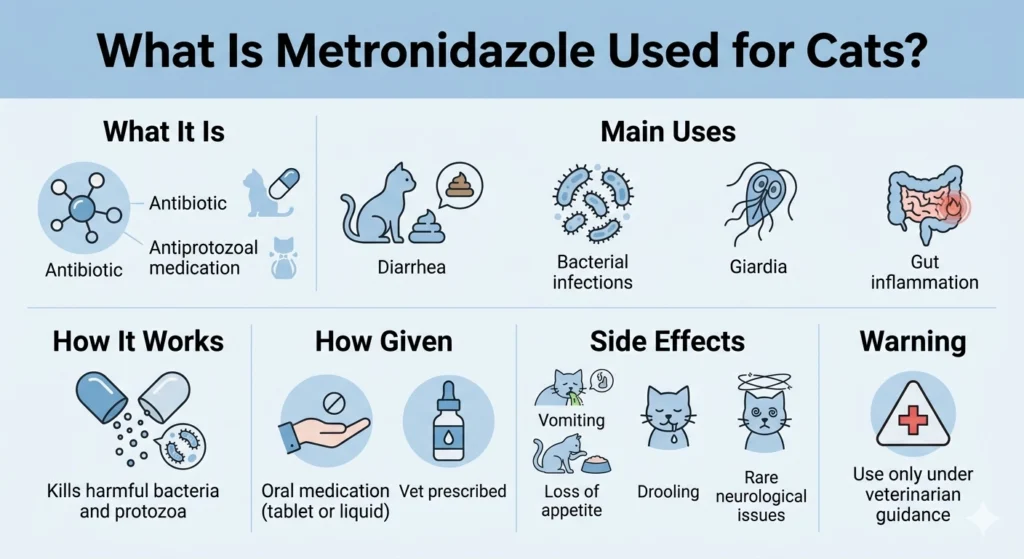
What Is Metronidazole Used for Cats?
Metronidazole is a veterinary medication of the prescription antibiotic and antiprotozoal drug category that is often used to treat and control a wide range of infections in cats. It acts through inhibiting the growth and reproduction of pathogenic bacteria and the elimination of certain protozoa parasites, and hence is particularly effective for gastrointestinal (digestive tract) conditions.
Primary Uses in Cats
Metronidazole is most commonly prescribed to treat:
- Digestive tract infections and inflammation
- Diarrhea, including those in which the cause is unknown
- Inflammatory Bowel Disease (IBD)
- Protozoal infections, especially:
- Giardia
- Trichomonas
- Balantidium coli
It is especially effective on anaerobic bacteria (bacteria that do not need oxygen to survive), which are typically a part of intestinal infections.


How Metronidazole Works in Cats?
Metronidazole is a powerful antibiotic and antiprotozoal drug, which acts by affecting the noxious bacteria and protozoa within a cat’s body, particularly those which thrive in the absence of oxygen (anaerobic organisms).

Mechanism of Action
- Metronidazole kills bacteria by interfering with their DNA, thus preventing them from growing and reproducing.
- In protozoa, it is thought to produce free radicals that damage the DNA of these parasites for the destruction of protozoa.
- By interfering in the DNA, the medication prevents new cells from forming, eventually leading to the death of the offending organisms.
Effect on Infections and Healing
- This action helps prevent the spread of infection in order to allow the immune system of the cat to recover and heal.
- Metronidazole is active against anaerobic bacteria and protozoa, so it can be used to treat a number of infections in cats.
Role in Inflammatory Conditions
- Also, metronidazole is used in inflammatory diseases of the digestive tract.
- It is thought to act by inhibiting some of the mechanisms of
- inflammation, helping to reduce inflammation.
Important Usage Points
- It should be administered with food for optimum effectiveness.
- Following the instructions of the veterinarian on dosages is necessary to avoid side effects such as neurological or liver problems.
- Veterinarians often prescribe it off-label, demonstrating its use of trust in the treatment of cats.
Metronidazole Dosage for Cats
The correct dosage of Metronidazole for cats is dependent on a number of important factors such as your cat’s weight, medical condition, and response to treatment. Since dosing is highly variable, this medication should never be administered without veterinary guidance.
General Dosage Guidelines
- The usual dosage for cats is between 5 and 30 mg per pound, or 10-60 mg/kg, one to four times a day.
- For most cases of diarrhea, a typical dose is approximately 7-10 mg/kg (3-5 mg/lb) 2 times a day.
- Some cases may be 7.5-10 mg/kg twice daily depending on severity and the veterinary recommendation.
Dosage for Specific Conditions
- Giardia infections: Usually higher doses of 10-25 mg/kg twice daily for about 5 days are required.
- Other infections or conditions may necessitate adjusted dosing, depending on the response of your cat.
Forms and Strengths Available
Metronidazole is available in several different ways to meet varying dosing needs:
Solid forms:
- 250 mg tablets
- 500 mg tablets
- 375 mg capsules
Liquid forms:
- 500 mg vials
- 5 mg/mL injectable solutions
- Liquid suspension (e.g. 200 mg/5 mL, typical dose is 0.18 mL/kg)
Compounded and Specialized Options
- For small cats or kittens, normal tablet sizes may be too large. In such cases, veterinarians may prescribe compounded formulations at customized doses.
- Compounded liquid versions can also contain flavoring to make administration easier.
- A liquid form, such as Ayradia (125 mg/mL) is FDA-approved for use in dogs and can be used off-label in cats, but is especially useful when the dose needed in cats is very small.
Administration and Duration
- Metronidazole is usually administered by mouth, with or without food.
- The treatment period is dependent on:
- The condition being treated
- Your cat’s response
- Any side effects that may develop
- It is important to finish the entire course of treatment, even if your cat seems to get better, to avoid symptoms recurring.
Important Safety Notes
- Dosage should always be prescribed by a veterinarian as incorrect dosage may be unsafe.
- Veterinarians may vary the dose based on severity of infection and response.
- If cost is an issue, pet insurance may be able to help pay for the cost of medication.
Following the prescribed Metronidazole dosage for cats is critical to ensure safe and effective treatment.
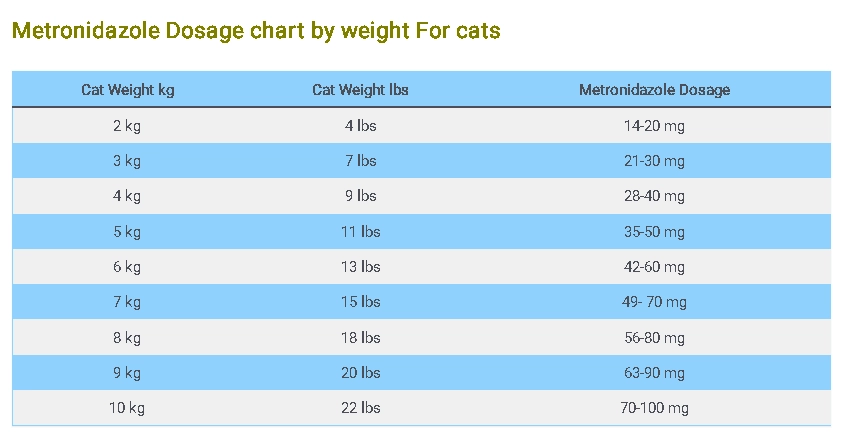
Metronidazole Dosage chart by weight For cats
| Cat Weight kg | Cat Weight lbs | Metronidazole Dosage |
|---|---|---|
| 2 kg | 4 lbs | 14-20 mg |
| 3 kg | 7 lbs | 21-30 mg |
| 4 kg | 9 lbs | 28-40 mg |
| 5 kg | 11 lbs | 35-50 mg |
| 6 kg | 13 lbs | 42-60 mg |
| 7 kg | 15 lbs | 49- 70 mg |
| 8 kg | 18 lbs | 56-80 mg |
| 9 kg | 20 lbs | 63-90 mg |
| 10 kg | 22 lbs | 70-100 mg |
To follow the Metronidazole Dosage chart by weight For cats, For safety, we suggest always sticking with the low dose until your vet advises to increase the dose.
How To Give Metronidazole to Cats
Giving Metronidazole to cats correctly is essential for safe and effective treatment. Always follow your veterinarian’s instructions and the directions on the medication label to ensure the best results.
Follow Proper Dosage Instructions
- The exact dose depends on your cat’s weight and the type of bacteria or parasite being treated
- Always give the medication exactly as prescribed by your veterinarian
- Complete the full treatment course, even if your cat’s symptoms improve, to prevent the condition from returning
Best Way to Administer Metronidazole
- Metronidazole is available as tablets, capsules, and liquid suspension
- Many cats tolerate the liquid form more easily, which can be prepared by a compounding pharmacy
- It is commonly recommended to give Metronidazole with food to reduce digestive upset
- In severe cases, a veterinarian may use an injectable form, especially if your cat cannot take medication by mouth
What to Expect After Giving the Medication
- After the first dose, the medication is absorbed within 1–2 hours
- Symptoms like diarrhea may start improving within a few days
Missed Dose Instructions
- If you miss a dose, contact your veterinarian for guidance
- In general:
- Give the dose when you remember, or
- Skip it if it’s close to the next scheduled dose
- Do not give double or extra doses
Important Safety Precautions
- Do not use Metronidazole in cats that are sensitive to this medication or similar drugs (5-nitroimidazole class)
- Follow all veterinary guidance carefully to avoid complications
Additional Notes
- Always ensure your cat finishes the entire prescription, even if symptoms like diarrhea have resolved
- Stopping early may cause symptoms to return and become harder to treat
Proper administration of Metronidazole for cats helps ensure effective treatment and supports a smooth recovery.
Can You Mix Metronidazole with Wet Cat Food?
Yes, Metronidazole can be mixed with wet cat food and this is often advised as the medication tastes very bitter and a lot of cats find this difficult to tolerate. To make administration easier, the tablet can be concealed in a small amount of canned food or a medication treat such as a pill pocket. If the tablet is not enteric coated, it can be crushed into smaller pieces and combined with soft food. However, it is important to use a small amount of food so your cat consumes the entire dose in one sitting in order to be effective.
While this method is helpful when it comes to administering the medicine, it is also important to keep a watchful eye for any serious side effects during the treatment process. These may include signs of an allergic reaction such as hives, fast heart rate, or difficulty breathing, behavior changes such as unusual tiredness or depression, trouble walking, tremors and twitching, dilated pupils, rapid movements of the eyes or seizures. These side effects may not show up right away and could take a few days to develop after the initial use of the medication, so constant observation is required.
In most cases, side effects improve after discontinuing the medication, but nerve-related side effects, such as tremors or difficulty walking, may take up to two weeks to completely improve. Although these complications may occur at any dosage, they are more likely to occur with higher doses or long-term use. Extra care should be taken when administering Metronidazole to cats with a history of seizures or kidney or liver issues in that they may be more likely to experience major side effects.
Side Effects of Metronidazole in Cats
Metronidazole is generally regarded as being safe and well-tolerated in cats especially in cats that are given the correct dosage as prescribed by a veterinarian. In fact, studies have shown that cats actually may not exhibit apparent side effects at appropriate doses.
However, like any type of medicine, it can still cause mild to serious side effects especially with high doses, long term, or overdosing.
Common Side Effects
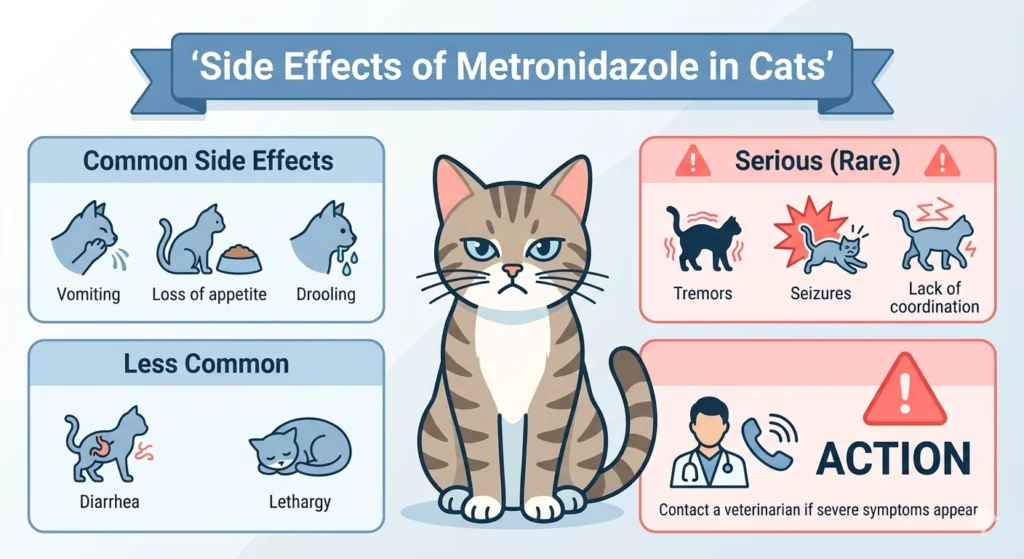
The most common side effects reported in cats are:
- Vomiting and nausea
- Diarrhea (in some cases, this is caused by interfering with healthy bacteria in the gut)
- Loss of appetite (inappetence)
- Lethargy or low energy
- Drooling or foaming at the mouth (usually because of the bitter taste)
- Gagging or pawing at the mouth
- Weakness
Loss of appetite is particularly important to watch for as cats who will stop eating for as little as 48 hours may be at risk of developing serious conditions such as fatty liver disease.
Digestive and Taste-Related Effects
Because Metronidazole has a bitter taste, some of the cats may:
- Refuse food
- Drool excessively
- Demonstrate signs of nausea or discomfort
In these cases, hiding the taste or using compounded flavored forms may be helpful in reducing these effects.
Serious and Rare Side Effects
Although less common, more severe reactions can also occur which require immediate veterinary attention:
Neurological Effects
- Lack of coordination (ataxia)
- Tremors
- Seizures
- Disorientation
- Head tilting
- Abnormal eye movements (nystagmus)
- Muscle rigidity
- Eye twitching
- Weakness or even blindness
These neurological symptoms are more likely in cats being treated on high doses or for long periods of time.
Liver and Organ-Related Effects
- Liver toxicity (hepatotoxicity)
- Yellowing of the gums, skin or eyes (jaundice)
- Dark or bloody urine (may be a kidney-related problem)
Without treatment, severe liver disorders can be life-threatening.
Skin Reactions (Rare)
- Vasculitis (inflammation of blood vessels within the skin)
- Symptoms include:
- Hair loss
- Bruising
- Swelling
- Skin scaling or bumps
While not normally a life-threatening condition, this condition needs immediate veterinary care.
Additional Risks And Interactions
- Metronidazole should be used cautiously in pregnant cats
- It should not be used in cats who have liver disease
- The medication may interact with other drugs, such as phenobarbital and cimetidine
Key Safety Insight
Most of the side effects are temporary and manageable, particularly when they are being used for short periods of time and for conditions such as diarrhea or infections. However, prolonged use or overdose can result in serious problems especially neurological and liver-related problems.
If you have any concerns about any unusual symptoms that occur while your cat is taking Metronidazole, contact your veterinarian immediately to ensure the safety and proper care of your pet.
Are There Any Alternatives to Metronidazole for Diarrhea in Cats?
Yes, there are a number of alternatives to Metronidazole in treating diarrhea in cats but the right choice totally depends on the underlying cause. Diarrhea in cats can be caused by numerous things, such as poisonous plants, spoiled food, infections, inflammatory bowel disease (IBD), or even intestinal tumors.
In some cases, diarrhea also may occur as a side effect of a previous antibiotic.
Common Alternatives Based on Cause
Depending on the diagnosis, veterinarians may suggest various medications:
- Fenbendazole (Panacur C):
Used for Giardia infections either alone or sometimes combined with Metronidazole - Tylosin:
Prescribed for treatment of inflammatory bowel disease (IBD) - Sulfasalazine:
Another option for treating IBD-related inflammation - Steroids (such as prednisolone):
Used in cases of IBD to reduce inflammation
Important Safety Guidelines
- Always consult with your veterinarian before opting for any alternative treatment
- Do not take over-the-counter (OTC) medications unless directed by the vet
- Do not use Pepto-Bismol which is related to aspirin and is, therefore, toxic to cats
- Do not use anything that includes acetaminophen (Tylenol) which is dangerous for cats
How To Store Metronidazole for Cats
Keep the following storage tips in mind for this medication:
- Ayradia (metronidazole oral suspension) should be stored in the upright position below 86 F°(30°C) and does not need to be refrigerated. Once opened, use within six months.
- Metronidazole tablets should be stored at controlled temperatures of 59–77°F (15–25°C).
- Keep the container tightly closed to protect it from moisture and light.
- Compounded medications should be stored according to the compounding pharmacy’s label.
- Keep out of reach of children and pets.
- Always confirm storage requirements by reviewing the label.
You May Also Like To Read:
FAQs: Metronidazole Dosage for Cats
What is the correct Metronidazole dosage for cats?
The dosage of Metronidazole for cats depends on their weight and condition. A typical range is 5–30 mg per pound (10–60 mg/kg) given one to four times daily, but your veterinarian will determine the exact dose.
What is the usual dose for diarrhea in cats?
For diarrhea, the common dosage is around 7–10 mg/kg (3–5 mg/lb) twice daily, depending on severity and your vet’s recommendation.
What dosage is used for Giardia in cats?
For Giardia infections, higher doses are often required, typically 10–25 mg/kg twice daily for about 5 days.
How many times a day should I give Metronidazole to my cat?
Metronidazole is usually given once to four times daily, depending on the condition being treated and your veterinarian’s instructions.
Can I adjust my cat’s Metronidazole dosage at home?
No, you should never adjust the dosage yourself. Always follow your veterinarian’s prescription, as incorrect dosing can lead to serious side effects or toxicity.
How long should my cat take Metronidazole?
The duration depends on the condition, your cat’s response, and any side effects. Always complete the full course unless your veterinarian tells you otherwise.
What happens if I miss a dose?
If you miss a dose, give it when you remember or skip it if it’s close to the next dose. Do not give a double dose. Contact your veterinarian for specific advice.
Can kittens take Metronidazole?
Yes, but kittens may require special dosing or compounded forms because standard tablets may be too large. Always consult your veterinarian.
Final Thoughts
Metronidazole is a popularly used antibiotic and antiprotozoal medication in veterinary medicine and is used by veterinarians to treat most forms of diarrhea as well as various infections in cats such as giardia. When used properly, it can be very useful in controlling the digestive problems and improving your cat’s health.
However, like any drug, Metronidazole must be carefully and responsibly used. Side effects such as drooling, vomiting and loss of appetite can occur but are more likely for higher doses or longer use and these symptoms are often improved once the medication is halted. In some cases, the drug is able to be toxic even in directed doses so close monitoring is essential.
It is extremely important to never give Metronidazole without a consultation to your veterinarian. It is used in cats off-label which means only a veterinarian can determine the safe and appropriate dosage based on your cat’s specific condition. Adjusting or modifying the dosing on your own can be dangerous and medications intended for humans should never be used in pets without veterinary guidance.
To ensure best results, always follow your vet’s instructions carefully, and complete a full course of treatment even if your cat seems to be better. Stopping early may result in return of the infection or the symptoms. If your cat does not improve after taking the last dose of medication, or develops any unusual side effects, you should contact your veterinarian right away.
Additionally, simple precautions such as washing your hands after giving the medication and closely monitoring for any adverse reactions may help ensure the safety of both you and your cat.
Ultimately, Metronidazole is a valuable and trusted treatment option in the field of feline care if it is used properly. By working very closely with your veterinarian, and keeping yourself up-to-date, you can be sure that your cat gets safe, effective, and current care especially as ongoing research continues to advance our understanding of this medication.