Determining the correct ivermectin dosage for cats is essential for safe and effective treatment of internal and external parasites.
While ivermectin is a powerful antiparasitic drug used widely in veterinary medicine, the margin of safety can be narrow for felines.
The standard ivermectin dose for cats generally ranges between 0.2 mg and 0.3 mg per kilogram of body weight, but this varies significantly based on the specific parasite being treated and the formulation used.
Because an overdose can lead to severe neurological toxicity, it is critical to consult a veterinarian before administering this medication.
Find the safe ivermectin dosage for cats with our detailed guide. Includes a dosage chart by weight, oral doses in ml/mg, side effects, and vital overdose warnings.



Disclaimer: This article is for informational purposes only and is not a substitute for professional veterinary advice. Ivermectin can be toxic or fatal if dosed incorrectly. Always consult a licensed veterinarian before administering this medication to your cat.
Key Takeaways
- Standard Dosage: The typical safe dose is approximately 0.2 mg to 0.3 mg per kg of body weight, but always verify with a vet.
- Formulation Matters: Never use livestock ivermectin (paste or pour-on) for cats due to the high risk of overdose and toxic ingredients.
- Common Uses: It is primarily used to treat ear mites, sarcoptic mange, and certain internal worms.
- Safety Warning: Ivermectin toxicity is a serious risk; symptoms include tremors, blindness, and seizures.
- Alternatives: Safer, FDA-approved alternatives like selamectin (Revolution) or imidacloprid (Advantage Multi) are often preferred for routine prevention.
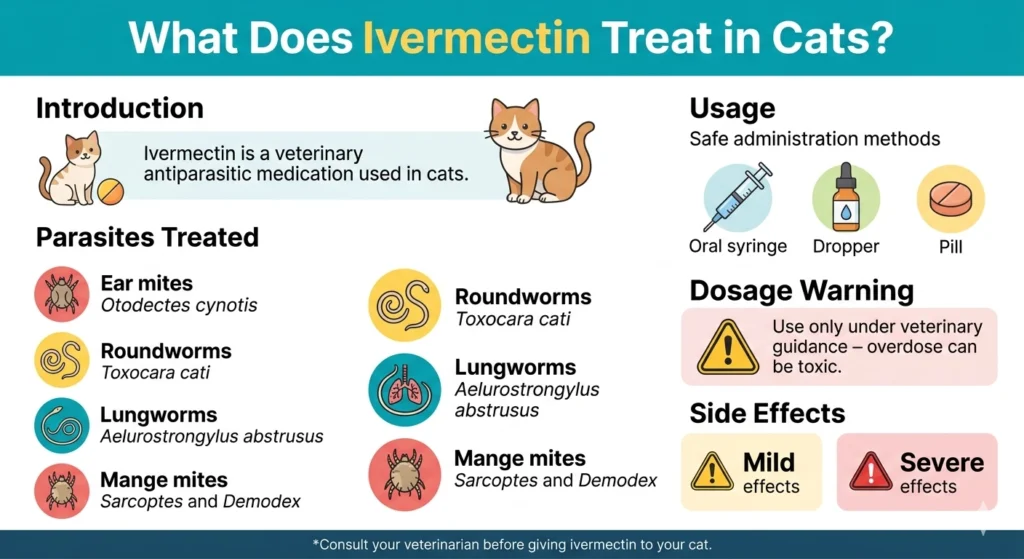
What Does Ivermectin Treat in Cats?
Ivermectin is a member of the avermectin family of drugs. It’s a broad-spectrum antiparasitic drug that is very effective against many of the parasites that affect our cats.
It is commonly used by cat owners to treat ear mites, but it has many other uses.


External Parasites:
- Ear Mites (Otodectes cynotis): This is probably the most common off-label use of oral or injectable ivermectin in cats. It will kill the mites in the ear.
- Mange Mites: It can treat notoedric mange (feline scabies) and sarcoptic mange, relieving severe itching and hair loss.
- Lice: It is used to treat biting lice (Felicola subrostratus).
Internal Parasites:
- Roundworms and Hookworms: While there are other dewormers often preferred for these, ivermectin does have efficacy against Toxocara cati (roundworms) and Ancylostoma tubaeforme (hookworms).
- Heartworm Prevention: In some formulations, ivermectin is used as a heartworm preventative, although products specifically designed for cats (like Heartgard for Cats) use a very low, precise dose.
Understanding what the drug treats is the first step; the next is ensuring the ivermectin dosage for cats by weight is calculated precisely to avoid toxicity.
How Does Ivermectin Work?
To appreciate the need for precision, it’s useful to know how it works. Ivermectin binds to glutamate-gated chloride ion channels in the nerve and muscle cells of parasites. These channels are crucial for nerve transmission in the parasite.
The binding of ivermectin to these channels results in an influx of chloride ions and hyperpolarization of the cell. This paralyses and kills the parasite.
Luckily, mammals (including cats) don’t have glutamate-gated chloride channels in their peripheral nervous system, so the drug is generally safe when used at the right dose.
But at higher concentrations, ivermectin can enter the brain of cats and interfere with other neurotransmitter systems, resulting in the toxicities described below.
Ivermectin for Cats: Dosage
Ivermectin dosage for cats is a mathematical exercise. This is not a “one size fits all” type of medication, and ivermectin is dosed by milligram per kilogram of body weight.
General Dosage Guidelines
The accepted ivermectin dosage for cats for most internal and external parasites is:
- 0.2 mg/kg to 0.3 mg/kg (milligrams per kilogram of body weight).
The dose used for heartworm prevention is much lower, typically 0.006 mg/kg (6 micrograms per kg), which is why it’s safer to use heartworm preventatives than trying to dose livestock products.
Ivermectin for Cats Dosage in mL vs. mg
The most common mistake is mixing up milligrams (mg) and milliliters (mL).
- Milligrams (mg): This is the amount of drug.
- Milliliters (mL): This is the amount of liquid you draw up in a syringe.
The ivermectin for cats dosage in ml will vary depending on the concentration of the product you are using.
- For example, if you are using a 1% ivermectin solution (10 mg/mL), a 4.5 kg (10 lb) cat would need 0.9 mg of drug if the dose is 0.2 mg/kg.
- Calculation: 0.9 mg ÷ 10 mg/mL = 0.09 mL.
- This is a very small volume to administer, which is why using products for livestock is risky. A small miscalculation can lead to a large overdose.
Oral Ivermectin Dosage for Cats
Oral ivermectin Dosage for Cats is commonly used for ear mites when topical products cannot be used. Ivermectin is well absorbed orally.
Some veterinarians will compound a liquid form for ease of measurement. When using the oral route, the drug may be administered every 7 to 14 days for 2 to 3 doses to kill all stages of the parasite.
Ivermectin Dosage Chart for Cats
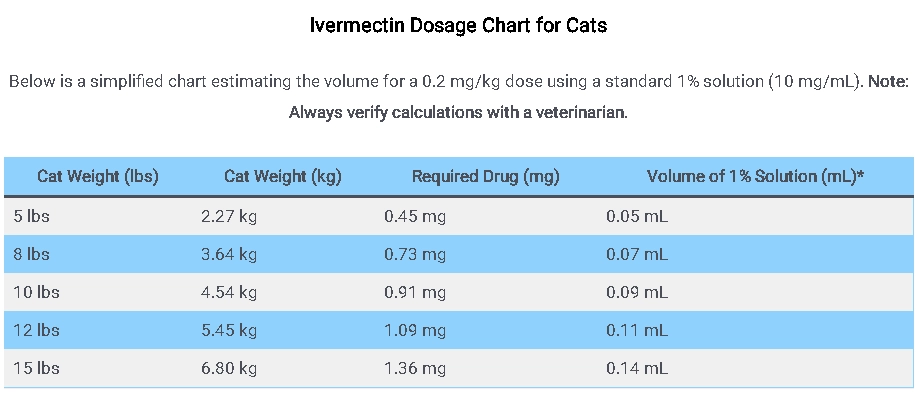
Below is a simplified chart estimating the volume for a 0.2 mg/kg dose using a standard 1% solution (10 mg/mL). Note: Always verify calculations with a veterinarian.
| Cat Weight (lbs) | Cat Weight (kg) | Required Drug (mg) | Volume of 1% Solution (mL)* |
|---|---|---|---|
| 5 lbs | 2.27 kg | 0.45 mg | 0.05 mL |
| 8 lbs | 3.64 kg | 0.73 mg | 0.07 mL |
| 10 lbs | 4.54 kg | 0.91 mg | 0.09 mL |
| 12 lbs | 5.45 kg | 1.09 mg | 0.11 mL |
| 15 lbs | 6.80 kg | 1.36 mg | 0.14 mL |
*This volume is extremely small and difficult to measure accurately with standard syringes. Precision is vital for safety.
Ivermectin Dosage for Cats Calculator
While there is no substitute for a veterinary consultation, understanding the math behind the ivermectin dosage for cats calculator logic can help you verify safety.
The Formula:
- Convert weight to kg (Pounds ÷ 2.2 = kg).
- Multiply kg by the prescribed dose (usually 0.2 to 0.3 mg/kg) to get the required mg.
- Divide the required mg by the concentration of your solution (usually found on the bottle as mg/mL) to get the mL volume.
Example Calculation:
- Cat: 11 lbs (5 kg).
- Desired Dose: 0.3 mg/kg.
- Math: 5 kg x 0.3 mg/kg = 1.5 mg of ivermectin needed.
- Product: 1% Solution (10 mg/mL).
- Final Volume: 1.5 mg ÷ 10 mg/mL = 0.15 mL.
If you are attempting to extract this from a horse paste (which is not recommended), the risk of error increases significantly because the plunger rings are designed for animals weighing hundreds of pounds.
How to Use Ivermectin for Cats Without Vet: Is it Safe?
The Google search term “how to use ivermectin for cats without vet” is common because owners are seeking affordable options. But this practice is fraught with danger.
Ivermectin is available over the counter for livestock, but using these products for cats is “off-label”. The primary dangers include:
- Risk of Overdose: As you can see in the chart above, the dose for cats is very small. Livestock products are formulated for 1,000 lb animals.
- Carriers and Solvents: Livestock products contain inactive ingredients that can be toxic to cats or cause severe vomiting and diarrhoea.
- Misdiagnosis: You could treat for mites when the cat has a bacterial or fungal infection, and delay treatment.
If you are going to do this, it is best to at least speak to a local clinic or veterinary hotline.
If you must do this, be sure to follow the ivermectin dosage for cats by weight and use a 1% injectable solution orally, as this is the least toxic of the high-concentration solutions, but still dangerous without veterinary advice.
Ivermectin Dosage for Cats: How Many Days?
The duration of treatment is just as important as the dose. Ivermectin is not always a “one-and-done” medication.
- Ear Mites: Usually a single dose, followed by another dose 2 weeks later. This will kill any eggs that hatch after the first dose.
- Mange: Can be given weekly or every other week for 4-6 weeks as injections or oral doses.
- Heartworm Prevention: Given once monthly.
For oral ivermectin for cats dosage chart protocols, veterinarians typically recommend giving it 14 days apart for external parasites to ensure the life cycle of the mite is covered.
It’s not necessary to give it every day or every other day and can be toxic.
Ivermectin for Cats: Side Effects
Ivermectin is generally safe when used at therapeutic doses. It is generally well tolerated but individual cats differ.
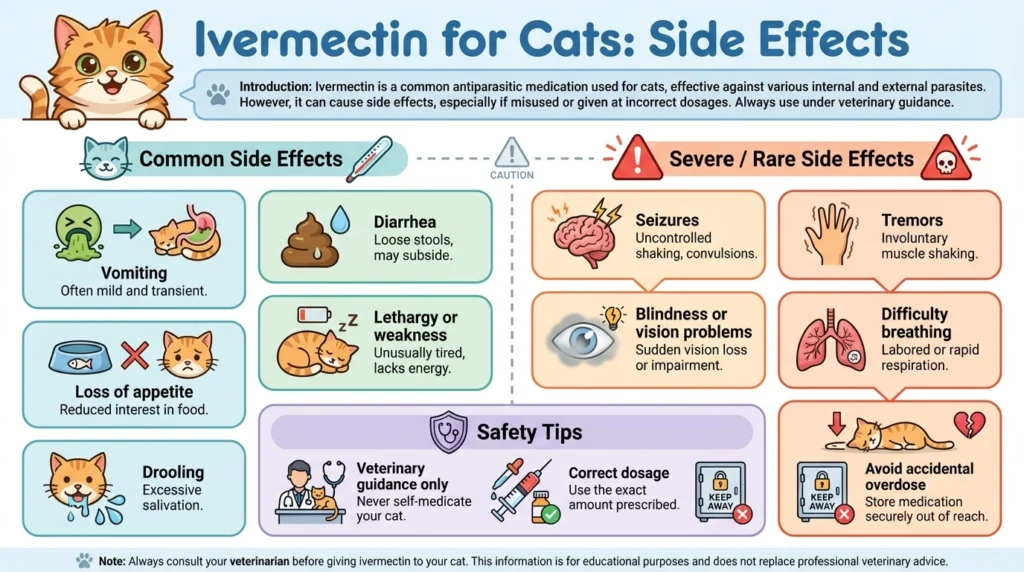
Common, Mild Side Effects:
- Salivation or frothing (often because of the bitter taste, if administered orally).
- Vomiting or diarrhea.
- Lethargy.
Ivermectin Side Effects in Cats: Toxicity
The biggest concern is toxicity, which can be caused by overdosage or using the wrong product. Ivermectin toxicity in cats can occur within hours of use. Symptoms include:
- Neurological Signs: Tremors, ataxia (incoordination), and seizures.
- Ophthalmic Signs: Pupillary dilation, temporary blindness, and nystagmus (rapid eye movements).
- Other Signs: Depression, disorientation, or agitation.
If you see these signs, it’s an emergency. Call your veterinarian or an emergency animal hospital right away. Ivermectin does not have an antidote; supportive care (IV fluids, nutrition) is provided until the drug is eliminated from the body.
Which Cats Should Not Take Ivermectin?
Some cats are at higher risk of ivermectin sensitivity. Although the MDR-1 gene mutation (which results in sensitivity in some dog breeds such as Collies) is not commonly reported as a risk factor in domestic cats, it’s best to be cautious.
Cats that should avoid or require careful monitoring with ivermectin:
- Kittens: Kittens (typically less than 6 weeks) may have a less developed blood-brain barrier, increasing the risk of neurotoxicity.
- Breeding Queens: Safety in pregnant or nursing cats has not been firmly established; other products are preferred.
- Cats with Other Diseases: Cats with liver or kidney disease may have slower metabolism of the drug, which can result in higher blood concentrations of the drug.
For these at-risk groups, veterinarians may opt for safer alternatives such as Selamectin (Revolution), Imidacloprid/Moxidectin (Advantage Multi), or Milbemycin oxime, which have a broader margin of safety.
Ivermectin vs Other Dewormers for Cats
Ivermectin is not the only dewormer, and it may not be the first choice for routine deworming. Ivermectin vs other dewormers for cats can be used to guide owners.
- Fenbendazole Dosage for Cats: Fenbendazole (Panacur) is commonly used for giardia, roundworms, hookworms and whipworms. It has a very wide safety margin and is safer for cats than ivermectin for internal parasites.
- Panacur Dosage for Cats: 50 mg/kg for 3-5 days for giardia. It is a powder mixed with food, and easier to administer than small liquid doses of ivermectin.
- Praziquantel Dosage for Cats: This is the drug of choice for tapeworms. Ivermectin does not kill tapeworms (Dipylidium caninum). It is sometimes mixed with pyrantel pamoate.
- Pyrantel Pamoate Dosage for Cats: This is great for roundworms and hookworms. It’s safe, cheap and often included in “kitten dewormers”.
Ivermectin is a “jack of all trades” but it is better to use a specific dewormer such as praziquantel for tapeworms or fenbendazole for giardia.
Safe Cat Worming Schedules with Ivermectin
If you and your veterinarian choose to use ivermectin, it should be part of a preventative program.
- Kittens: Begin worming at 2-3 weeks of age with pyrantel, not ivermectin.
- Adults: Regular heartworm prevention (may contain low dose ivermectin) is monthly.
- Mites: Once diagnosed, treat.
Prevention is better than cure. A monthly topical such as Revolution (Selamectin) prevents fleas, ear mites, heartworms and some intestinal worms and may eliminate the need for high-dose ivermectin Dosage for cats calculations.
You May Also Like To Read:
FAQs
Is it OK to use horse ivermectin paste for my cat?
It’s not recommended. Horse paste is very concentrated and may contain apple flavoring or other ingredients that are toxic to cats. The amount of ivermectin needed for a cat is a fraction of the smallest line on a horse syringe, and there is a strong likelihood of overdose.
How much ivermectin should I use for ear mites in cats?
The dose is usually 0.2 mg to 0.3 mg per kg body weight, by mouth or injection, repeated in 2 weeks. But topical products such as selamectin are now recommended for safety and convenience.
How do I administer such a low dose of ivermectin?
For cats, you need an insulin syringe (U-100 or U-50) which has very fine gradations to measure volumes as small as 0.01 mL or 0.05 mL accurately. Livestock syringes are too big and not accurate enough.
Can I use ivermectin on pregnant cats?
Ivermectin should only be used in pregnant cats if the risk outweighs the benefit. Other options are generally preferred. Ask your vet before giving a pregnant queen any medication.
How long does ivermectin remain in cats?
Ivermectin has a half-life of 2-3 days in cats, so it may take 1-2 weeks for it to be completely cleared from the system. That’s why overdoses can lead to prolonged clinical signs and the need for prolonged supportive care.
Final Thoughts
While ivermectin dosage for cats is a potent tool in the fight against parasites, it demands respect and precision.
The narrow margin between a therapeutic dose and a toxic dose means that “eyeballing” the measurement is never an option.
Whether you are dealing with stubborn ear mites or looking for a heartworm preventative, the safest route is always through a veterinary prescription.
Understanding the ivermectin dosage chart for cats and the math behind ivermectin for cats dosage in ml empowers you to be a better pet owner, but professional guidance ensures your cat stays healthy and safe.
With safer alternatives like Revolution, Advantage Multi, and traditional dewormers available, there are often better options that provide peace of mind alongside effective treatment.