Itraconazole is a commonly used oral antifungal medication for cats, especially for treating ringworm and other fungal infections. It belongs to a group of drugs called triazoles, which work by blocking the formation of the fungal cell membrane, stopping the fungus from growing.
Veterinarians prescribe itraconazole for a wide range of infections, including those caused by Microsporum canis (ringworm), as well as Candida, Aspergillus, and Cryptococcus. It can treat skin, subcutaneous, and systemic fungal infections, making it a versatile option for cats. It is available in forms like veterinary oral solutions (Itrafungol) and human brands such as Sporanox.
In this guide on Itraconazole Dosage for Cats, you’ll learn the correct dosage, how it works, what it treats, and important safety tips to keep your cat healthy.
Disclaimer: This content is for informational purposes only and should not replace veterinary advice. Always consult your veterinarian before giving Itraconazole or adjusting your cat’s dosage.


What Is Itraconazole for Cats?
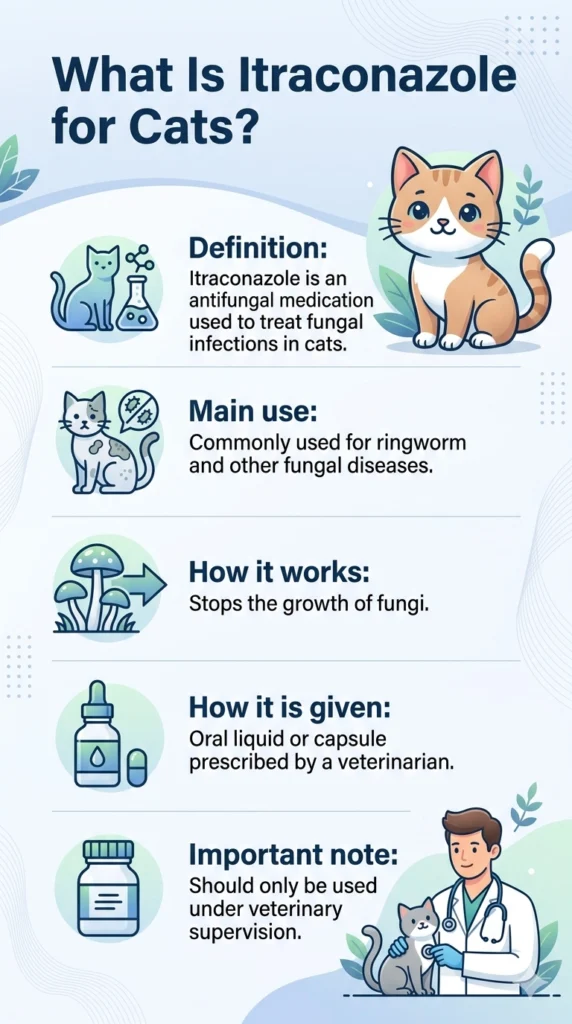
Itraconazole is a prescription antifungal drug that is used in cats for the treatment of various types of fungal infections. It belongs to a group of drugs called triazoles which works by preventing the growth and spread of fungi in the body.
Veterinarians usually prescribe itraconazole for ringworm (the most common fungus infection in cats), as well as more serious infections that affect the skin, lungs, or internal organs. It is effective against many types of fungi such as Microsporum canis, Candida, Aspergillus and Cryptococcus.
This type of medication is typically administered orally, in either a liquid solution or capsules. In many cases, itraconazole is viewed as a first choice treatment format as it is effective and generally well-tolerated when taken at the correct dosage.
In simple words, itraconazole aids control and eradication of fungal infection in cats hence making it an important part of veterinary treatment plans.


What Itraconazole Does for Cats
Itraconazole is an antifungal medicine primarily used as a treatment for ringworm (dermatophytosis) in cats, most often caused by Microsporum canis. Even though this name sounds confusing, ringworm is actually not a worm – it’s a fungal infection that typically manifests itself as hair loss, scaly skin and crusty patches and is most commonly found on the head, face and ears.
This infection spreads easily by way of direct contact with infected animals or contaminated surfaces. The fungal spores can live in the environment for 12 to 18 months, which makes it easy for cats to get reinfected. Some cats, particularly longhaired cats, can also be carriers, meaning that they spread the infection even though they are not showing visible signs.
Itraconazole works by stopping the growth of the fungus this helps the infection to clear up over time. It is usually used when:
- The infection is spread to multiple areas
- The cat may be a carrier
- Topical treatments are not sufficient
For minor cases, vets may employ antifungal creams or lotions. But for more serious cases, itraconazole is often used in combination with:
- Antifungal shampoos
- Lime sulfur dips
- Ongoing topical treatment
Treatment usually takes several weeks to a few months but it is usually very good when followed properly.
In addition to ringworm, itraconazole is used (off-label) to treat other fungal infections in cats including:
- Malassezia (yeast skin infections)
- Aspergillosis
- Cryptococcosis
- Coccidioidomycosis
- Sporotrichosis
- Blastomycosis
- Histoplasmosis
Overall, itraconazole helps control and treat both common and serious fungal infections making it an important medication to keep cats healthy.
Itraconazole Dosage for Cats
The proper itraconazole dosage for cats should always be determined by a veterinarian, as it depends on several important factors such as the weight, age, overall health and severity of the infection of the cat. This medication is prescription-only and it is very important to use the correct dosage in order to be safe and effective.
For treatment of ringworm caused by Microsporum canis*, the standard dosing guideline for FDA-approved veterinary product (Itrafungol) is as follows:
- 5 mg/kg of body weight just by mouth once daily
Administered for 7 days and then have a break - This cycle is repeated on alternating weeks for 3 treatment cycles
Itraconazole is usually available as an oral solution which can usually be administered with or without food where veterinary preparations such as Itrafungol are used. However, some human formulations (such as Sporanox oral solution) are usually recommended to be administered without food to enhance absorption.
The length of treatment may vary according to:
- The type and intensity of the fungal infection
- To what extent the cat’s body responds to the medication
- Whether any side effects develop
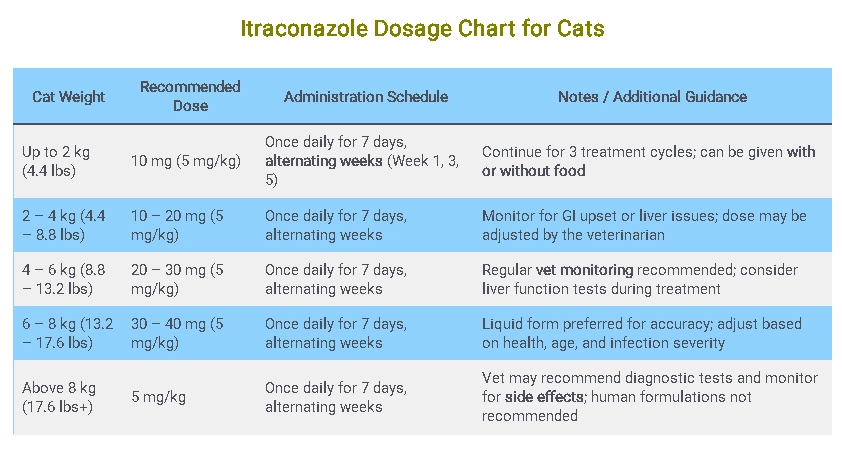
Itraconazole Dosage Chart for Cats
| Cat Weight | Recommended Dose | Administration Schedule | Notes / Additional Guidance |
|---|---|---|---|
| Up to 2 kg (4.4 lbs) | 10 mg (5 mg/kg) | Once daily for 7 days, alternating weeks (Week 1, 3, 5) | Continue for 3 treatment cycles; can be given with or without food |
| 2 – 4 kg (4.4 – 8.8 lbs) | 10 – 20 mg (5 mg/kg) | Once daily for 7 days, alternating weeks | Monitor for GI upset or liver issues; dose may be adjusted by the veterinarian |
| 4 – 6 kg (8.8 – 13.2 lbs) | 20 – 30 mg (5 mg/kg) | Once daily for 7 days, alternating weeks | Regular vet monitoring recommended; consider liver function tests during treatment |
| 6 – 8 kg (13.2 – 17.6 lbs) | 30 – 40 mg (5 mg/kg) | Once daily for 7 days, alternating weeks | Liquid form preferred for accuracy; adjust based on health, age, and infection severity |
| Above 8 kg (17.6 lbs+) | 5 mg/kg | Once daily for 7 days, alternating weeks | Vet may recommend diagnostic tests and monitor for side effects; human formulations not recommended |
Key Guidelines:
- Formulation: Prefer Itrafungol (veterinary-approved) for safety and absorption. Human formulation (Sporanox) may require fasting.
- Prescription Only: Always use under veterinarian supervision. Do not self-prescribe.
- Treatment Duration: Typically 3 cycles (Week 1, 3, 5), continue at least 1 month beyond a negative fungal test.
- Monitoring: Regular vet check-ups, liver function tests, and monitoring for GI upset or other side effects are essential.
- Individual Variation: Dosage may vary based on age, weight, severity of infection, or concurrent health conditions.
How to Give Itraconazole to Cats
Itraconazole is generally administered to cats by mouth in a form of a liquid oral solution (but in some cases, capsules may be used). Always follow your veterinarian’s precise dosage and schedule.
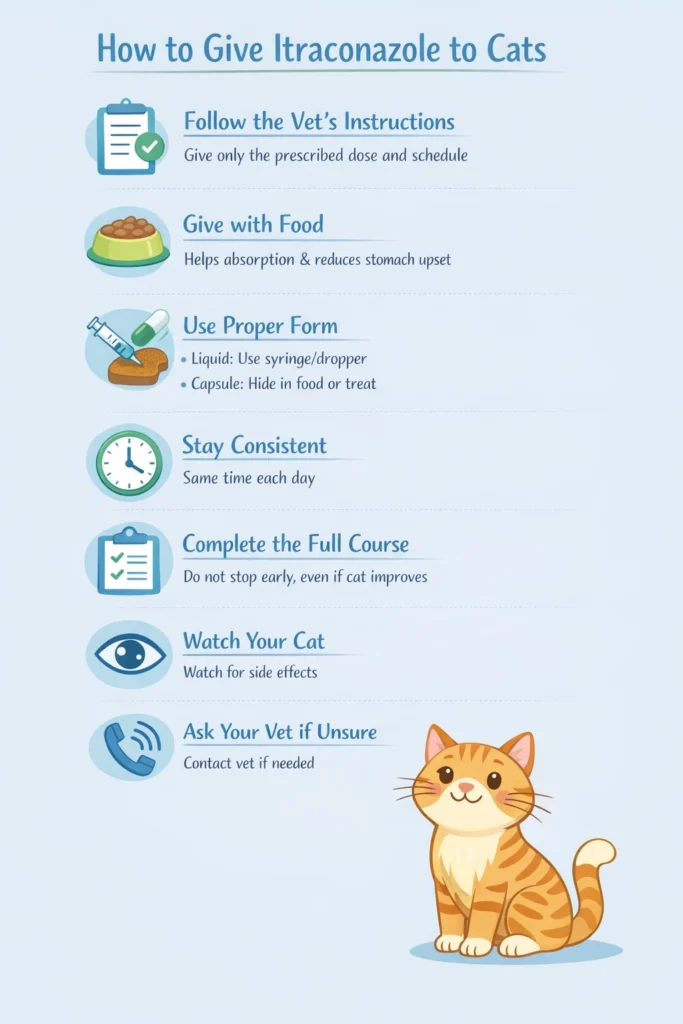
If you are using the liquid form, gently measure the correct dose and give it directly into your cat’s mouth using a syringe. This can be the easiest and most accurate method. The veterinary oral solution may generally be administered with or without food where as some human formulations may be better administered on an empty stomach for proper absorption.
If your cat is prescribed capsules they should be administered whole. If your cat has trouble swallowing pills ask your veterinarian before crushing or opening them as this may affect how the medication works.
To make the process easier:
- Give the medicine at the same time every day
- Remain calm and handle your cat gently
- Give a small treat or reward afterwards to alleviate stress
How Long a Cat Should Take Itraconazole
The duration of treatment with itraconazole in cats depends on the type of fungal infection and how responsive the cat is to the treatment. For ringworm there is a certain way it is treated, which is usually used.
Cats are usually treated in cycles:
- Given itraconazole for week 1, week 3 & week 5
- No medication during week 2 and 4
This alternating schedule helps in improving its effectiveness and reducing the side-effects which may arise.
Both Itrafungol (for cats), and Sporanox (for humans) are well absorbed in cats when used appropriately. However, liquid forms are preferred as human capsules aren’t absorbed as well, and often contain a dose that is too high for the majority of cats.
Treatment usually lasts several weeks but it’s very important to take medication exactly as prescribed. Even if your cat’s skin appears to have healed, the infection may remain. In most cases, treatment should continue for at least one month after a negative test result (such as a culture or PCR) in order to make sure the infection is completely gone.
Compounded Itraconazole for Cats
Compounding medications are very common in the veterinary field. This is because we are able to administer medical therapy to our animal patients through different dosage routes. It also makes dosing easier depending on the form of a medication or the flavor of a medication.
However, in the case of itraconazole specifically it is recommended to not use a compounded form. Studies have proven that these forms are far less bioavailable and less effective than the FDA-approved brands.
The brand that has been approved by the FDA for use in cats is called itrafungol and also includes a dosing syringe. The syringe is used to allow for the most accurate dosing in cats. This is important, considering that there seems to be a higher risk of side effects with inappropriate doses.
Is Itraconazole Safe for Cats?
Itraconazole is generally safe for cats when used under veterinary guidance and at the correct dosage. It is a prescription-only medication, and following your veterinarian’s instructions is essential to prevent complications.
Most cats tolerate itraconazole well, but, like all medications, it can have side effects, especially if given in the wrong dose or for too long. Potential side effects include loss of appetite, vomiting, diarrhea, lethargy, and, in rare cases, liver problems. Regular monitoring by a veterinarian, including blood tests, may be recommended during long-term treatment to ensure the cat’s liver and overall health remain stable.
The risk of side effects can be minimized by:
- Administering the correct dose based on your cat’s weight and condition
- Using veterinary-approved formulations such as Itrafungol
- Avoiding self-prescribing human formulations without veterinary advice
When used properly, itraconazole is a highly effective and safe treatment for both common and more serious fungal infections in cats. Following the prescribed course fully and monitoring for any unusual symptoms ensures your cat gets the maximum benefit with minimal risk.
Side Effects of Itraconazole for Cats
Itraconazole is generally safe and effective when prescribed by a veterinarian and used as directed. However, like all medications, it can cause side effects, which are usually dose-dependent. Higher doses increase the risk of gastrointestinal problems and liver toxicity.
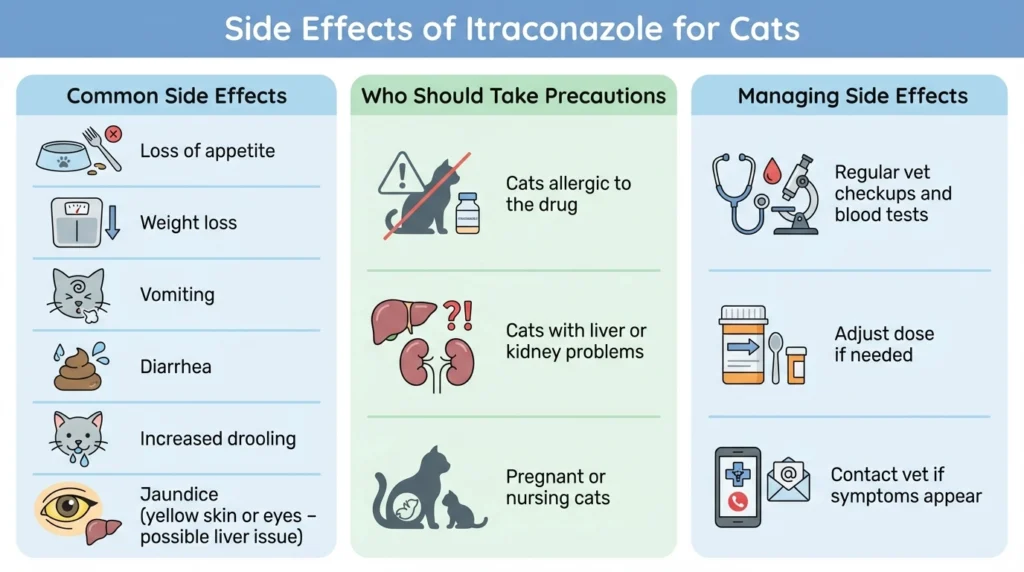
Common Side Effects
- Loss of appetite
- Weight loss
- Vomiting
- Diarrhea
- Increased drooling
- Jaundice (yellowing of the skin or eyes, indicating possible liver issues)
Who Should Take Precautions
Itraconazole should not be used in cats with:
- Hypersensitivity to the drug
- Existing liver or kidney problems
- Pregnant or lactating cats
Managing Side Effects
- Regular monitoring: Veterinarians may recommend blood tests to check liver function, especially if digestive upset occurs.
- Dose adjustments: Depending on side effects, the vet may lower the dose, increase the interval between doses, or temporarily stop treatment.
- Immediate action: Contact your vet if any symptoms appear or if your cat’s behavior changes.
Compared to other antifungal medications, itraconazole tends to have fewer side effects, but careful monitoring is crucial to prevent serious complications like hepatitis or liver failure. Following the prescribed instructions and staying in regular contact with your veterinarian ensures that any adverse reactions are addressed promptly, keeping your cat safe throughout treatment.
You May Also Like To Tead:
FAQs
What is itraconazole used in cats?
Itraconazole is an antifungal drug used to treat ringworm (dermatophytosis) and other fungal infections in cats such as Malassezia infection, aspergillosis, cryptococcosis and sporotrichosis. It helps prevent the growth of fungus and clear fungal infections safely when used under veterinary guidance.
How much itraconazole to give to my cat?
The standard FDA approved dose for ringworm is 5mg/kg of bodyweight, orally once daily for 7 days on alternate weeks for 3 cycles. The specific dose may vary, depending on the weight, age, health, and type of infection of the cat, so always follow your veterinarian’s prescription.
How long does it take for a cat to take itraconazole?
Treatment usually lasts for several weeks often after the alternating weeks of ringworm. It is important to keep going even if your cat seems healed, usually one month after a negative culture or test to get rid of the infection.
Can itraconazole be fed to cats with food?
Veterinary medications for oral administration such as Itrafungol can generally be administered with or without food. Some human formulations such as Sporanox are advised on an empty stomach for better absorption. Follow the instructions of your vet carefully.
Is itraconazole Safe for Kittens or Pregnant Cats?
Itraconazole should only be used with caution in kittens, pregnant or lactating cats and under strict veterinary supervision. Cats with liver or kidney problems also must be carefully monitored during treatment.
How do I know if itraconazole is working for my cat?
Signs of improvement include healing of the skin lesions, reduced hair loss and less scaly patches. Your veterinarian may want to repeat cultures or tests to make sure the infection is gone.
What do I do if my cat misses a dose of itraconazole?
Do not double the next dose. Give the missed dose as soon as you can if it’s close to the time it’s supposed to be given. Otherwise, maintain the normal dosing schedule and call your veterinarian for advice.
Final Thoughts
Itraconazole is a common and effective antifungal medication for cats, mainly used to treat ringworm, especially in cats with multiple lesions or carrier states. While generally safe, gastrointestinal issues and liver effects can occur, usually depending on the dose. The FDA-approved veterinary form, Itrafungol, is recommended for best results.
It is essential to follow your veterinarian’s guidance for dosing and treatment duration. Never adjust doses on your own or give human medications to your cat without veterinary supervision. Working closely with your vet ensures safe, effective treatment and a full recovery.