As a cat owner, few things are more stressful than watching your feline friend suffer from an infection.
Whether it’s a stubborn urinary tract issue, a painful abscess from a tussle with the neighborhood cat, or a skin infection that won’t seem to heal, you want answers—and fast.One of the most common antibiotics veterinarians reach for in these situations is Clavamox.
But if you’ve been prescribed this medication, you likely have questions. How much should you give? What exactly does it treat? Are there side effects you should watch for?
And perhaps most importantly, how do you get that tiny pill or liquid into a cat who has suddenly developed an uncanny ability to dodge every attempt at medication?
This comprehensive guide walks you through everything you need to know about Clavamox dosage for cats, drawing on veterinary expertise and FDA-approved guidelines to help you navigate your cat’s treatment with confidence.



Remember, while this information is thoroughly researched, it should always be used in consultation with your veterinarian who knows your cat’s specific health history.
Clavamox dosage for cats: weight-based chart, liquid & tablet dosing, side effects, and safety warnings.
Disclaimer: This guide is for informational purposes only and is not a substitute for professional veterinary advice.
Always consult your veterinarian before giving Clavamox or any medication to your Cat.
Key Takeaways
Before diving into the details, here are the essential points every cat owner should know about Clavamox:


- Standard feline dosage: 62.5 mg (1 ml of liquid suspension) given every 12 hours
- Treatment duration: 5-7 days for skin infections, 10-14 days for urinary tract infections
- Available forms: Chewable tablets (62.5 mg, 125 mg, 250 mg, 375 mg) and oral liquid suspension (50 mg amoxicillin/12.5 mg clavulanate per ml)
- Liquid storage: Must be refrigerated after mixing and discarded after 10 days
- Common side effects: Decreased appetite, vomiting, diarrhea—most often mild and temporary
- Critical warning: Never use in rabbits, guinea pigs, or other small herbivores—it can be fatal
- Not effective against: Viral infections (like many upper respiratory infections) or parasites
What Is Clavamox for Cats?
Clavamox is a prescription antibiotic drug belonging to the so-called penicillin family, but with a strong twist. Its generic name is amoxicillin trihydrate with clavulanate potassium.
While amoxicillin is a broad spectrum antibiotic alone that fights many types of bacteria, it has a weakness: some types of bacteria produce an enzyme called beta-lactamase that can destroy amoxicillin before it does its job .
This is where clavulanate comes in. Clavulanate potassium acts as a beta-lactamase inhibitor – in other words, it disarms that bacterial defense mechanism so that the amoxicillin can work effectively against bacteria that would otherwise be resistant.
Think of it as a two-part system, one part attacks the bacteria and the other disarms the defense mechanisms of the bacteria.
The combination is so effective that it’s often referred to as a “potentiated penicillin” because its effect is stronger and broader than amoxicillin alone.
This makes Clavamox Dosage For Cats especially useful in treating infections where the specific bacteria may not be immediately known, or the bacteria may be immune to the normal antibiotics.
Clavamox Dosage For Cats is FDA-approved for use in cats and dogs, and is available only by prescription from a licensed veterinarian.
This isn’t a medication that you can grab off a shelf-and that’s on purpose, because proper dosing and proper use are so important in both effectiveness and safety.
When to Use Clavamox for Your Cat
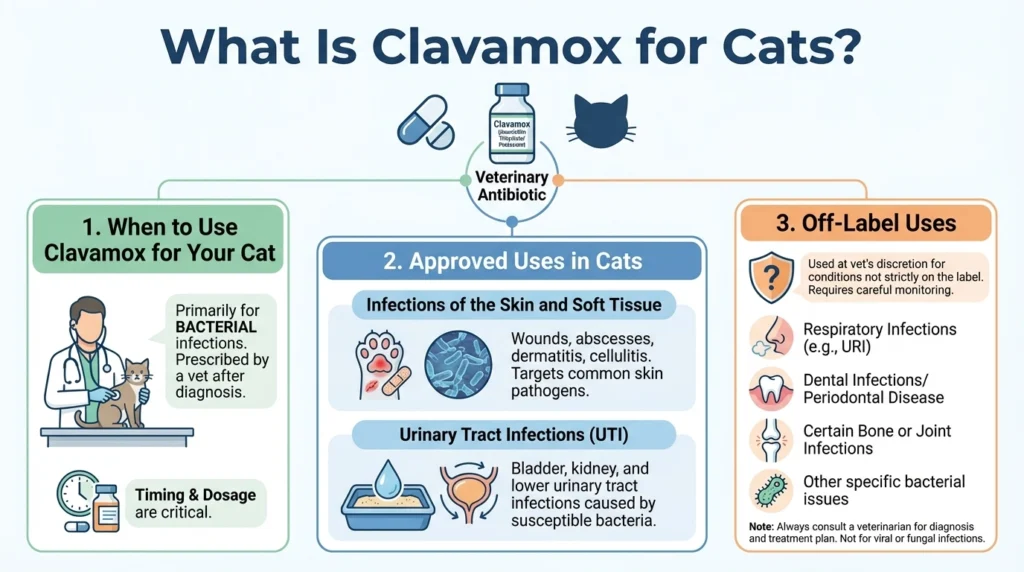
Your veterinarian may use Clavamox for a number of types of bacterial infections. Understanding what this medication treats – and what it does not treat – helps you be a more informed advocate for the health of your cat.
Approved Uses in Cats
The following are the conditions for which Clavamox has been specifically approved for use in cats by the FDA :
Infections of the Skin and Soft Tissue
These include wounds, abscesses (which are often the result of cat fights), cellulitis (inflammation of connective tissue) and dermatitis.
The species of bacteria usually implicated in these infections are Staphylococcus aureus, Streptococcus species, Escherichia coli (E. coli) and Pasteurella species – all of which are usually susceptible to Clavamox .
Urinary Tract Infections (UTI)
Clavamox is very effective against E. coli which is the most common cause of feline UTIs. If your cat is straining during urination, urinated outside of the litter box or has blood in the urine, your veterinarian may prescribe Clavamox after determining a bacterial infection is the cause.
Off-Label Uses
Veterinarians may also prescribe Clavamox “off-label” for any other condition for which there is evidence of its ability to treat that condition, including:
Respiratory tract infections: Infection of lungs, sinuses or airways due to susceptible bacteria
Periodontal (gum) disease: Although this is officially approved for dogs, some vets use this for cats with severe dental infections
What Clavamox Does NOT Treat
- It’s equally important to know what Clavamox won’t do. This antibiotic does not have any effect on :
- Viral infections: Most upper respiratory infections in cats are viral infections rather than bacterial. Clavamox will not help with these but they may be prescribed to prevent secondary bacterial infections.
- Parasitic infections Worms, mites, fleas and other parasites need different medications.
- Fungal infections: Conditions such as ringworm require treatment with antifungals, not antibiotics.
This is why your veterinarian will not usually prescribe antibiotics without an examination. Using antibiotics when we don’t need them contributes to antibiotic-resistant bacteria, and makes it harder to treat an infection in the future.
What Does Clavamox Do for Cats?
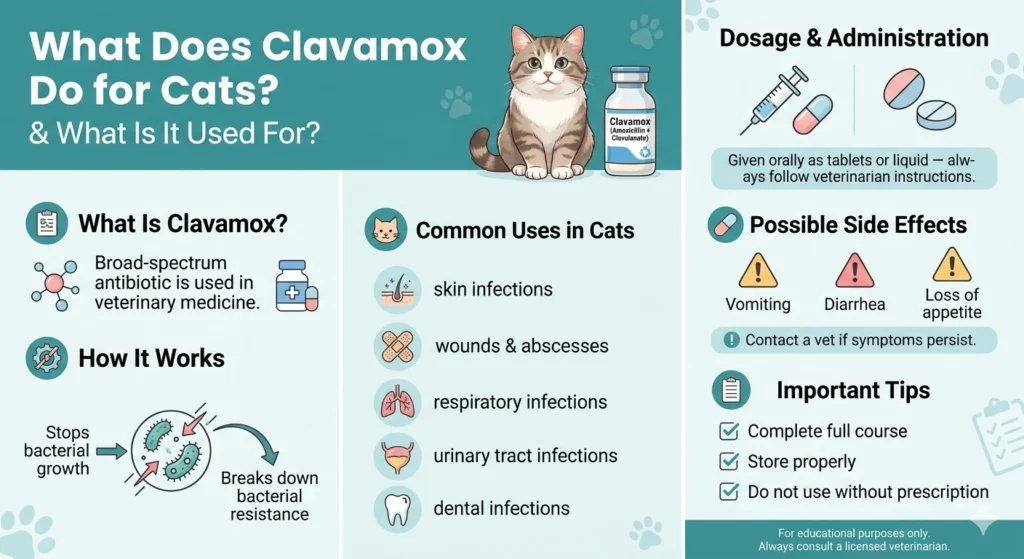
To know how Clavamox works, let’s get a little science-friendly. Bacteria have cell walls which protect them and keep their cell structure intact.
The way Amoxicillin works is by interfering with the formation of these cell walls . When the susceptible bacterium attempts to divide and grow, it cannot build new cell wall material appropriately.
The cell wall becomes weak and unstable and the bacterium practically bursts and dies .
This makes amoxicillin a “bactericidal” antibiotic – it will kill bacteria directly instead of just making them slower to grow.
The problem is that some bacteria make an enzyme called beta-lactamase which can break apart the amoxicillin molecule before it gets to its target.
These bacteria are said to be “resistant” to amoxicillin. There is a drug called clavulanate potassium. This compound binds to beta-lactamase enzymes and inactivates them, paving the way for the amoxicillin to do its job .
When you give your cat Clavamox, the medicine is absorbed quickly from the digestive tract. Peak concentrations in the blood occur in one to two hours.
From there, it diffuses into most body tissues and fluids – but, although it can enter the brain or spinal fluid (unless the meninges – the protective layers around the brain – are inflamed), it doesn’t diffuse well.
Most of the amoxicillin is eliminated unchanged in the urine, which is the reason that Clavamox is such a good antibiotic for urinary tract infections.
About 15 percent of the clavulanate component is also eliminated through the urine in the first six hours .
Clavamox Dosage for Cats
This is the information most cat owners are looking for and it’s important that it’s gotten right. The recommended dosage of Clavamox for cats is easy and weight-adjusted, but there are some nuances depending on the degree of medication and the condition being treated.
The Standard Dosage
Clavamox dosage for most cats is 62.5 mg given twice a day approximately every 12 hours .
This standard dose works for the majority of cats because it’s designed around the average feline body weight.
However, your veterinarian may alter this dose for very small kittens (who may require a lower dose) or very large cats (who may require a higher dose, using the 6.25 mg per pound guideline used for dogs) .
Dosage by Formulation
Liquid Suspension (Clavamox Drops)
- Concentration: 50 mg amoxicillin/ 12.5 mg clavulanate per ml
- Standard dose: 1 ml (this is equal to 62.5 mg total) twice per day
- How to measure: Use the dosing syringe that comes with it, not a kitchen spoon
Chewable Tablets
- Available strengths: 62.5 mg, 125 mg, 250 mg and 375 mg
- Standard dose: One 62.5mg tablet twice daily
- For cats requiring more than 62.5 mg your vet will prescribe a combination of whole tablets – never ever split tablets unless specifically told to
Treatment Duration Guidelines
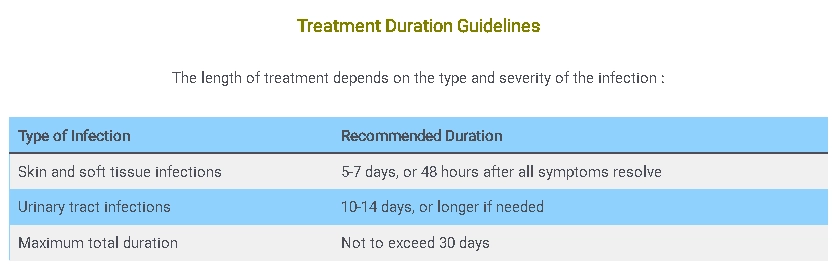
The length of treatment depends on the type and severity of the infection :
| Type of Infection | Recommended Duration |
|---|---|
| Skin and soft tissue infections | 5-7 days, or 48 hours after all symptoms resolve |
| Urinary tract infections | 10-14 days, or longer if needed |
| Maximum total duration | Not to exceed 30 days |
When to Reevaluate
Your veterinarian will want to check up on the progress of your cat. Specific guidelines include :
- Skin infections: In case no improvement is observed after 3 days of treatment, it is necessary to reevaluate the case
- Other infections If no response is seen after 5 days then therapy should be stopped and the case reassessed
These reevaluation points are important because they help to ensure that your cat is on the right antibiotic. If Clavamox isn’t working, its continued use won’t help and could delay more effective treatment.
What If You Miss a Dose?
- Life happens and sometimes, a dose gets missed. Here’s how to handle it :
- If you’re near the time you were supposed to take the medicine (within a few hours), take the dose as soon as you remember
- If it’s closer to the next scheduled dose, skip that skipped dose completely
- Never give a double dose to make up for a missed dose
- Excessive time in the hospital can sometimes make it difficult to keep up a regular schedule and take the entire course of medication
It is important to complete the full course of any prescription even if your cat appears to be getting better. Stopping early can mean that the most resistant bugs might survive and be able to develop resistance .
Dosage Forms of Clavamox for Cats
Clavamox has two main forms and knowing the differences can help you and your veterinarian select the one that is best for your cat’s personality and your lifestyle.
Liquid Oral Suspension (Clavamox Drops)
- Appearance: A pinkish liquid, usually flavored to make it more palatable
- Concentration: 50 mg of amoxicillin activity and 12.5 mg of clavulanic acid activity per ml
- Reconstitution: The liquid is in a bottle in powder form. Your veterinarian or pharmacist will put in water (14 ml) and shake it hard to make the suspension
- Storage: Once mixed, the liquid has to be stored in the refrigerator. It is good for 10 days and any unused portion should be discarded
- Administration: Use the dosing syringe provided for measuring the correct amount. Gently squirt the liquid into the side of your cat’s mouth but not directly down the throat to prevent aspiration
- Best for: Cats who are hard to pill or they won’t eat food containing tablets
Chewable Tablets
- Appearance: Pork liver flavored tablets that most cats seem to prefer
- Available Strengths- 62.5 mg/125 mg/250 mg/375 mg
- Storage: Tablets should be stored in their original foil blister packaging until they are to be used as the clavulanate component is sensitive to moisture
- Administration: Can be administered as a treat, mixed in food or in the mouth
- Important note: Tablets should not be split or crushed unless your veterinarian specifically directs you to do so. The remainder of a half of a tablet could lose potency before the next dose
- Best for: Cats who take treats willingly or accept pilling with little too much of a fight
Which Form Is Right for Your Cat?
This decision is often based on your cat’s personality. Some cats enjoy the chewable tablets and gobble them right up. Others are suspicious of anything that smells like medicine.
The liquid may be easier to give to resistant cats, but some cats find the taste off-putting. Your veterinarian can help you decide and he or she may suggest trying one form and making a switch if it’s not working out.
Clavamox vs. Augmentin: What’s the Difference?
This is a common question among cat owners, particularly those who may have Augmentin left over from a prescription for a human or in search of a cheaper alternative.
The short answer is no, they are not interchangeable, and you should never use Augmentin in place of Clavamox without veterinary guidance .
They Contain the Same Active Ingredients
Both Clavamox and Augmentin contain Amoxicillin and Clavulanate Potassium. Augmentin is the combination’s human branded version
But They Are Formulated Differently
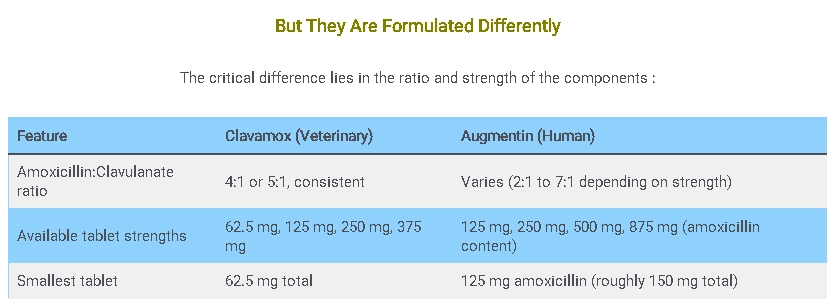
The critical difference lies in the ratio and strength of the components :
| Feature | Clavamox (Veterinary) | Augmentin (Human) |
|---|---|---|
| Amoxicillin:Clavulanate ratio | 4:1 or 5:1, consistent | Varies (2:1 to 7:1 depending on strength) |
| Available tablet strengths | 62.5 mg, 125 mg, 250 mg, 375 mg | 125 mg, 250 mg, 500 mg, 875 mg (amoxicillin content) |
| Smallest tablet | 62.5 mg total | 125 mg amoxicillin (roughly 150 mg total) |
Why This Matters for Your Cat
The smallest tablet of Augmentin is almost two times larger than standard Clavamox for cats . Giving this to a cat might be an overdose or, more likely, severe gastrointestinal upset.
Additionally, the different ratios means that you can’t just calculate an equivalent dose – you’d be giving a different balance of the two components than what’s been studied and proven safe for cats.
Safety Considerations
Beyond the issue of dosing, there’s another important point to consider: human versions can come with ingredients (such as certain flavorings or preservatives) that aren’t tested for safety in cats.
Your veterinarian has specific reasons to prescribe Clavamox instead of something else, and cost should not be the only factor in that decision .
If you have concerns about the cost of Clavamox, consult with your veterinarian. They may be able to suggest alternatives, provide samples, or be able to help you find a reputable pharmacy with competitive pricing.
Side Effects of Clavamox for Cats
Like any drug, Clavamox may cause side effects. Fortunately, the majority are mild and temporary. Knowing what to look for is in order to be able to respond appropriately and know when to call the veterinarian.
Common Side Effects
These are side effects on the digestive system and are the most frequently reported :
Decreased Appetite (Anorexia)
This is actually the most reported side effect in cats. Some cats eat less when they are taking antibiotics. If your cat does not eat at all, call your veterinarian as soon as possible – cats can develop serious liver issues from going a longer time without food.
Vomiting
If vomiting occurs, try to administer the medication with some food . The food can help buffer the stomach and decrease the nausea.
Diarrhea or Loose Stool
Antibiotics may affect the balance of normal bacteria in the gut. This usually goes away after completion of the medication. Your veterinarian may recommend probiotic to help restore the healthy gut flora .
These side effects on digestion are often not severe and tend to get better with continued use. However, if they’re severe or persistent, call your veterinarian.
Managing Digestive Side Effects
Here are some strategies that can help
- Give with food: Even a little food will minimize upset stomach
- Consider the use of probiotics: Ask your vet about adding a feline probiotic during treatment
- Monitor hydration: Make sure your cat is still drinking water, especially in the event of diarrhea
- Don’t stop suddenly: Always talk to your vet about stopping drugs
Allergic Reactions (Rare but Serious)
While rare, allergic reactions to penicillin-class antibiotics may be seen. Symptoms of an allergic reaction include :
- Hives or skin rash
- Facial swelling
- Fever
- Difficulty breathing
- Sudden collapse
If you see any of these symptoms, discontinue the medication immediately and call your veterinarian or an emergency veterinary hospital immediately. Severe allergic reactions can be treated with epinephrine and steroids .
When to Call Your Veterinarian Immediately
Contact your vet immediately if your cat is affected by :
- Loss of appetite for longer than 24 hours
- Severe or bloody diarrhea
- Persistent vomiting
- Signs of an allergic reaction
- Unusual lethargy or weakness
Accidental Overdose
The chewable tablets are flavoured to be palatable which means some cats may attempt to eat more than they should if they get into the bottle.
If you think that your cat has ingested a too large amount of medication – i.e. by getting into the medication bottle or being accidentally double dosed – contact your veterinarian, an emergency veterinary hospital or animal poison control center immediately.
- ASPCA Animal Poison Control Center: 888-426-4435
- Pet Poison Helpline: 855-764-7661
What Bacteria Does Clavamox Treat?
One of the reasons that Clavamox is such a valuable antibiotic is that it is a broad spectrum antibiotic. It’s effective for many types of bacteria that are the common cause of infections in cats.
Gram-Positive Bacteria
These bacteria have a thick cell wall against which amoxicillin is effective. Clavamox works against :
- Staphylococcus aureus (including beta-lactamase producing)
- Staphylococcus species
- Streptococcus species
Gram-Negative Bacteria
These bacteria have a more complex cell wall which some antibiotics have difficulty penetrating. With clavulanate disabling the resistance mechanism, Clavamox is active against :
- Escherichia coli (E. coli) – most common cause of UTI in cats
- Pasteurella multocida and other species of Pasteurella – common in bite wounds
- Proteus mirabilis
- Klebsiella pneumoniae
- Enterobacter species
Anaerobic Bacteria
These bacteria grow in the absence of oxygen and are frequently involved in deep tissue infections, abscesses and dental disease. Clavamox has activity against a lot of anaerobes .
Susceptibility Testing
If your cat has a recurrent infection, or isn’t responding to treatment, your veterinarian may perform a bacteria culture and sensitivity test.
This means taking a sample from the infected area and growing the bacteria in a lab to determine exactly what is there and what antibiotics will work best. While this takes a few days, this can be invaluable in stubborn or complicated infections.
Special Precautions and Warnings
Cats Who Should NOT Take Clavamox
Clavamox is not safe for all cats. Do not use this drug if your cat :
- Has a known allergy to penicillin, cephalosporins or other beta-lactam antibiotics
- Is rabbit, guinea pig, chinchilla, hamster etc (can be fatal)
Use with Caution
Extra caution is needed for:
- Pregnant or nursing cats: Safety has not been established for breeding animals or pregnant animals
- Cats with kidney or liver disease: Dosing may need to be adjusted
Human Safety Considerations
If you’re handling Clavamox, then do the following
- Washing your hands well after administering the meds
- Avoid handling if you are allergic to penicillin-type antibiotics
- Keep all medicines out of reach of children and pets
- Do not crush tablets or handle the liquid if you have a known allergy
Drug Interactions
Clavamox may interact with other drugs. Be sure to inform your veterinarian of any other drugs, supplements or herbal products your cat is taking. Specific interactions to be on the lookout for :
- Other antibiotics: Chloramphenicol, erythromycin, sulfonamides and tetracyclines may be effective against Clavamox, making it less effective
- Methotrexate: This cancer drug will reach toxic levels when combined with Clavamox
- Warfarin: Blood-thinning effects may be increased, increasing the risk of bleeding
Yoyu May Also Like To Read:
FAQs
Wife: Can I give my cat Clavamox without food?
Yes Clavamox can be given with or without food . However, if your cat undergoes stomach upset or vomiting with the on the empty stomach, try giving your cat with little food or a treat.
Clavamox Maximum How long does Clavamox take to work?
Clavamox starts to work in 1-2 hours from taking it It can be a good regression of symptoms from the exact point of your cat can be seen in 24 to 48 hours however it is important to finish course of antibiotics even if your cat looks better.
What if my cat spits up the liquid or pill?
If your cat is spitting out a dose, repeat the process with a new dose. If you have ongoing problems, contact your veterinarian. They may have tips to administer the medicine or a medication switch may be due in another form of the medicine.
Can I take Clavamox from another infection?
No. Never use medicine from another antibiotic or a leftover antipsychotic medicine. The infection could be otherwise, the meds could have expired (especially liquid forms), and the partial courses of antibiotics contribute to bacteria resistance. Always obtain a new prescription from your vet.
How should I store Clavamox?
Tablets: Contains must store at room temperature in original foil packaging to protect from moisture
Liquid suspension Refrigerate after mixing and use within 10 days
All forms Keep out of reach of pets and children
Is Clavamox safe for kittens?
Clavamox can be used in kittens and dosages may need to be adjusted weight. Your veterinarian will know what dose to give to your young cat. The safety of use in very young/lactating animals has not been totally established .
My cat seems better. Is it possible to discontinue the drugs early?
No. Even if your cat seems to be feeling completely better, it is important to finish the full course of antibiotics prescribed . Stopping too soon can result in survival of the strongest bacteria and the development of a relapse or antibiotic resistant bacteria.
What if my cat has diarrhea on Clavamox?
Mild diarrhea is quite common and usually resolves after discontinuation of the medication. You can ask your veterinarian about the administration of a probiotic during treatment. If the diarrhea is severe, bloody, or is for a patient that is vomiting or lethargic, contact your veterinarian .
Can humans take Clavamox?
No. Clavamox is a drug for veterinary use only. Never take medication prescribed for your pet or give your pet medication prescribed for humans without the veterinary guidance .
Final Thoughts
Clavamox is one of the most reliable and frequently prescribed antibiotics in veterinary medicine for good reason.
Its combination of amoxicillin and clavulanate potassium provides a powerful, broad-spectrum approach to treating common feline infections, from bite wounds to urinary tract issues.
As with any medication, the key to success lies in proper use. Following your veterinarian’s dosage instructions, completing the full course of treatment, and watching for side effects are all essential parts of helping your cat recover.
When in doubt, reach out to your veterinary team—they’re your best resource for ensuring your feline friend gets the care they need.
Remember, this guide is intended to inform and educate, but it doesn’t replace a veterinarian’s professional judgment. Your cat’s health is unique, and your vet has the expertise to tailor treatment to your specific companion.
Here’s to quick recoveries and healthy, happy cats.